Biblical Vegetarianism and its Revival
One doesn’t have to look far today to encounter a vast array of information about supposedly life-altering diets. What went into the body similarly fascinated – if not obsessed – the increasingly literate and health-conscious men and women of seventeenth-century England. Chief among them, this blog post highlights, was the renowned polymath Sir Thomas Browne. Browne stood out for his time, we will see, in that he extolled vegetarianism principally on health grounds even when discussing biblical abstinence from meat-eating. In downplaying the sacrificial component of the act in favour of a more secular perspective, he highlighted the role that scripture could play in inspiring and validating a broader reformation of eating habits that equally reflected the changing priorities of the time.
Plants and Plant-Based Diets
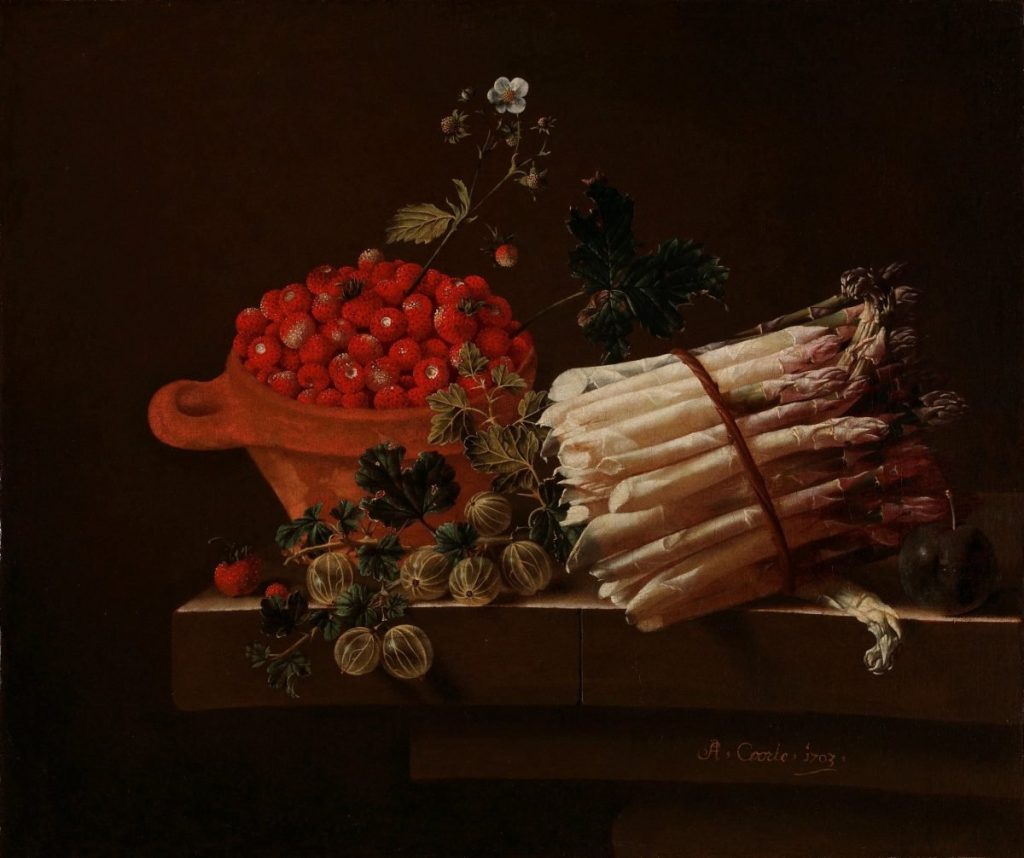
The interest in vegetable-based diets that sprung up in Browne’s day had multiple justifications and modes of expression. In one sense, it simply reflected a growing recognition of the impressive properties of even fairly common plants. As artists such as Adriaen Coorte honoured the features of locally-grown fruits and vegetables in focused still-lifes such as “A Pot of Strawberries, Gooseberries, and a Bundle of Asparagus on a Stone Plinth” (1703), scientific texts including Nehemiah Grew’s Anatomy of Plants (1682) showcased the complex inner-workings of everyday shrubs and trees in graphic engravings. It is against this backdrop that the diarist John Evelyn wrote his Acetaria, A Discourse of Sallets (1699), which champions the benefits of consuming the “universal Tribe of Sallets”. Evelyn explained that one should balance hot and dry salads that are “friendly to the Brain” with cold and moist ones that are “Bitter and Stomachical”, and deemed lettuce to have a particularly impressive array of benefits, noting that it “represses Vapours, conciliates Sleep, mitigates Pain; besides the effect it has upon the Morals, Temperance and Chastity”.1
As I’ve discussed elsewhere, some figures of the period, such as Pierre Gassendi and Margaret Cavendish, defended vegetable-based diets partially on the basis of animal ethics.2 Others, especially theologians, regarded periodic abstinence from meat-eating as an important act of bodily sacrifice. In The Paschal or Lent-Fast (1662), the Lady Margaret’s Professor of Divinity in Cambridge Peter Gunning pointed out that it had been decreed in England as early as 1549 that no one “shall at any time after the first day of May” willingly and wittingly “eat any manner of flesh [including fish], after what manner of kind or sort soever it shall be ordered, dressed or used, upon any Frid[a]y or Saturday, or the Emb[e]ring dayes, or in any day in the time commonly called Lent”.3 Were they to have obeyed the law rigorously, Englishmen and women would, under this regimen, have ended up as vegetarians for roughly 100 days each year in a bid to subjugate “the flesh to the Soul and Spirit”.4
In spite of the growing interest in vegetables and vegetable-based diets, the health benefits of vegetarianism were still not well understood. Calling for a rigorous programme to prove (or disprove) the physiological effects of a vegetable-based diet through a historical and cultural analysis, the Royal Society fellow Daniel Cox thus encouraged members of the fledgling institution in 1668 to make “A comparison between times[,] nations and Persons that lived most and Least on vegetables” in order to determine “whither Plants are better for food then Animals”. Cox had his suspicions, predicting that the study would reveal that “the preservation of Health and Prolongation of Life may bee procured by Vegetable Food & Physick derived only from Vegetables”.5 Indeed, such a hypothesis reflects the widely held view that antediluvian humans lived so long because their diets were vegetable-based.
Browne on Daniel’s Diet
Browne was a prolific author who touched on myriad, often curious, themes over the course of his life. As noted, he is also a prominent example of a figure who made a health-based case for a vegetarian diet chiefly by summoning scripture. In doing so, he helped to demonstrate the ongoing ability of the Bible to assist in answering the kinds of historical and cultural questions that near-contemporaries such as Cox posed under a more scientific guise.
In a chapter “Concerning the common course of Diet, in making choice of some Animals, and abstaining from eating others” that Browne added to his Pseudodoxia Epidemica (1646), he strung together a litany of queries, asking:
whether it were not best to conform unto the simple diet of our fore-fathers, whether pure and simple waters were not more healthfull then fermented liquors; whether there be not an ample sufficiency without all flesh, in the food of honey, oyl, and the several parts of milk: in the variety of grains, pulses, and all sorts of fruits; since either bread or beverage may be made almost of all? whether nations have rightly confined unto severall meats? or whether the common food of one countrey be not more agreeable unto another? how indistinctly all tempers apply unto the same, and how the diet of youth and old age is confounded.6
In essence, Browne was describing a comparative history of diet much like that which Cox envisaged, which he hoped might extend to a medical account of whether the diets of one region could be beneficially adopted elsewhere. Browne’s interesting speculation about whether we’re right to confound the diets of the young and old may have been prompted by knowledge of the fact that Galen (according to Evelyn) ate “Lettuce in his younger Days” but ceased to do so “when he grew old”.7 Although research into these matters was limited, Browne explained that they were “considerations much concerning health, and might prolong our daies”.
In “Observations upon Several Plants mention’d in Scripture”, which was posthumously published in 1683 as part of Certain Miscellany Tracts, Browne addressed, by way of an analysis of the prophet Daniel’s famed diet of pulses, water, fruits, nuts, and bread, at least the first few (more historical) questions that he posed in Pseudodoxia.8 What Daniel had eaten for the three years that he spent in Babylon, training in the literature of the Chaldeans, had been the source for much of the theological commentary on fasting. In this context, abstinence from meat-eating was typically depicted as a symbolic act – a way to deprive the body of flesh, reform and control the self, and ultimately enter communion with God. According to St Chrysostom, for example, in the words of Gunning, a “man may undergoe the labour of fasting, and not receive the reward thereof” when he abstains “from meats, but not from sins”. The argument goes that fasting makes one physically weak, but that weakness can paradoxically be a source of mental strength. St Ambrose made the very similar point that “when the flesh is lessened by fastings”, the “soul [is] fatned with purity”.9
For Browne, however, Daniel’s example offered clear evidence that a vegetable-based diet actually increases physical strength. As he wrote:
Now that herein (beside the special benediction of God) he [Daniel] made choice of no improper Diet to keep himself fair and plump and so to excuse the Eunuch his Keeper, Physicians will not deny, who acknowledge a very nutritive and impinguating faculty in Pulses, in leguminous Food, and in several sorts of Grains and Corns, is not like to be doubted by such who consider that this was probably a great part of the Food of our Forefathers before the Floud.
Browne added, following Pliny, that the Romans “fed much on Pulse for six hundred years” and that, in Roman times, “the Athletick Diet was of Pulse, Alphiton, Maza, Barley and Water; whereby they were advantaged sometimes to an exquisite state of health”. It therefore made sense to Browne that “though Daniel were no Eunuch, and of a more fatning and thriving temper”, he was, “by this kind of Diet, sufficiently maintained in a fair and carnous state of Body, and accordingly his Picture not improperly drawn, that is, not meagre and lean, like Jeremy’s, but plump and fair, answerable to the most authentick draught of the Vatican”.

Daniel’s modified vegan diet has received a good deal of recent attention from online health advice sites, and it even piqued the interest of scientists, with a fairly recent paper (from 2010) in Lipids in Health and Disease investigating the “Effect of a 21 day Daniel Fast on metabolic and cardiovascular disease risk factors in men and women” and concluding that the diet significantly improves cardio-metabolic profiles.10 At least some modern medical research, then, supports Browne’s historical (but, he claimed, medically sanctioned) account of the nutritive nature of pulses.
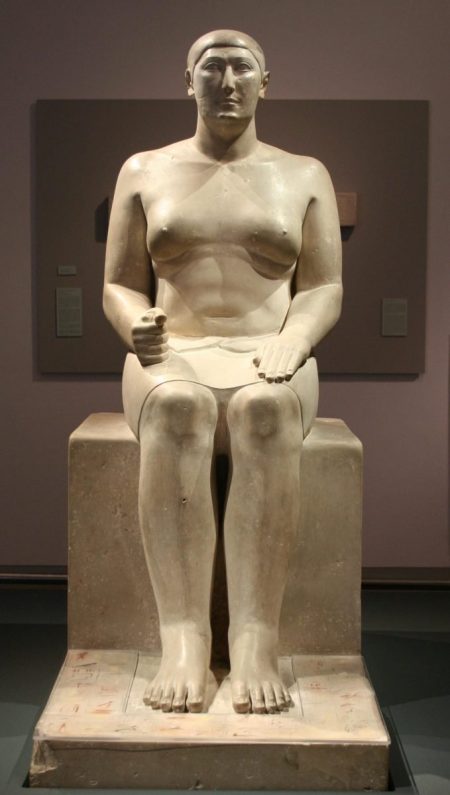
Providing further evidence to make his case that a vegetarian diet did not necessarily crucify the flesh, Browne observed that the “present Aegyptians, who are observed by Alpinus to be the fattest Nation, and Men to have Breasts like Women, owe much, as he conceiveth, unto the Water of Nile, and their Diet of Rice, Pease, Lentils and white Cicers”. In other words, in those who were not training for the Olympics, pulses and grains could have quite a different effect, fattening rather than bulking out the body. Browne’s hypothesis as to why some Egyptian men had enlarged breasts is, however, not bolstered by modern science to the same extent as his supposition that pulses help with general health. Although a long-time fascination of scientists and archaeologists, the apparent gynecomastia represented in ancient Egyptian art was probably due to an association of androgyny with divinity, rather than a medical condition, or, indeed, a pulse-based diet.11 Here, the Italian natural historian Prospero Alpini, who was so often a reliable botanist, appears to have led Browne astray: Alpini’s “observations” in Egypt were, presumably, prejudiced by his cultural assumptions.
Browne also held that a vegetable-based diet promotes longevity, which would have made it of particular interest to his contemporaries. In the fashion of Aristotle’s De longitudine et brevitate, Pliny’s Natural History, and Lucian’s Macrobii, Browne offers exempla of long-livers as proof of the benefits of vegetarianism.12 This includes “The Pulse-eating Cynicks and Stoicks, [who] are all very long livers in Laertius” (i.e. Diogenes Laërtius’s Lives and Opinions of Eminent Philosophers), and antediluvian humans, who “without the eating of flesh […] preserved themselves unto longer lives, then their posterity by any other”.13 Moreover, he pointed out that Daniel, “being carried away Captive in the Reign of Joachim, by King Nebuchadnezzar, lived, by Scripture account, unto the first year of Cyrus”. Browne indicated that Daniel’s diet was a major factor in his living into his mid-to-late 80s. Interestingly, Aristotle had linked a supply of extra blood and fat to longevity on the basis that they restrict the drying out that causes ageing, so if rice, peas, and lentils were able to promote fat growth then that may account for why they could promote longevity, too.
Longevity has almost always been regarded as desirable – not least in the seventeenth century, which witnessed an obsession with life extension. Fatness, however, has a more contentious history. Older studies tended to regard the early modern period as a “time before fat”, when fatter bodies were generally regarded as more healthful and fertile than slimer ones.14 But more recent studies argue that slimness was already the preferred body shape at this time, and the textbooks and dissertations that Michael Stolberg has analysed do suggest a concern with an excess of body fat as early as the sixteenth century.15 Although far from a deep-dive into the matter, Browne’s elevation of Daniel’s plump shape and that of the apparently larger Egyptians indicates the prevalence of a culture that celebrated bigger bodies. Having said that, opting for a diet of lentils and water over one of meat and wine would hardly have been a standard prescription for promoting weight gain.
References
- Evelyn, John (1699): Acetaria: A discourse on sallets, London: Printed for B. Tooke, pp. 88–89, 31, https://doi.org/10.5962/bhl.title.51228.
- Begley, Justin (2022): Animals in Early Modern Thought, in: Dana Jalobeanu and Charles Wolfe (eds.): Encyclopedia of Early Modern Philosophy and the Sciences, Cham: Springer, pp. 69–83, https://doi.org/10.1007/978-3-319-31069-5_628.
- Gunning, Peter (1662): The Paschal or Lent-Fast, London: Printed by R. Norton for Timothy Garthwait, pp. 535–536.
- Ibid., p. 536.
- Cox, Daniel (1668): A History of Vegetables, Royal Society of London, CI.P/10i/8, f. 26, 30.
- Browne, Thomas (2018): Book 3: Of popular and received tenents concerning animals, in: Kevin Killeen (ed.): Thomas Browne: Selected Writings, Oxford: Oxford University Press, pp. 227–330, here p. 313.
- Evelyn 1699, p. 33.
- Browne, Thomas (1683): Observations upon Several Plants mention’d in Scripture, in: Certain Miscellany Tracts, London: Printed for Charles Mearn, pp. 15–18. All subsequent quotations from Browne’s Observations are within this page range.
- Gunning 1662, p. 177, 221.
- Bloomer, Richard J. et al. (2010): Effect of a 21 day Daniel Fast on metabolic and cardiovascular disease risk factors in men and women, in: Lipids in Health and Disease, vol. 9, no. 94, pp. 1–9, https://doi.org/10.1186/1476-511X-9-94.
- Oranges, C.M. et al. (2017): Gynecomastia in the Ancient Egypt limestone statue of Hemiunu, the architect of the Great Pyramid of Giza (fl. 2570 BC), in: Journal of Endocrinological Investigation, vol. 40, pp. 337–338, https://doi.org/10.1007/s40618-016-0566-x.
- Schäfer, Daniel (2011): Old Age and Disease in Early Modern Medicine, Abingdon/New York: Routledge, p. 22.
- Browne 2018, p. 308.
- Levy-Navarro, Elena (2008): The Culture of Obesity in Early and Late Modernity, New York/Basingstoke: Palgrave Macmillan, https://doi.org/10.1057/9780230610439.
- See, for instance, Forth, Christopher E. (2019): Fat. A Cultural History of the Stuff of Life, London: Reaktion Books; Stolberg, Michael (2012): ‘Abhorreas pinguedinem’: Fat and obesity in early modern medicine (c. 1500-1750), in: Studies in History and Philosophy of Biological and Biomedical Sciences, vol. 43, no. 2, pp. 370–378, https://doi.org/10.1016/j.shpsc.2011.10.029.
SUGGESTED CITATION: Begley, Justin: Biblical Vegetarianism and its Revival. Thomas Browne on the Origins of a Fad Diet, in: KWI-BLOG, [https://blog.kulturwissenschaften.de/biblical-vegetarianism-and-its-revival/], 23.10.2024