Artificial memory, artificial thought
Mental operations, like physical tasks, can be more or less difficult. Some concepts are harder to grasp than others, some mental tasks require time and careful attention, others instead can be done quickly and without much effort. For these reasons, if physical labor can be facilitated using tools, it is quite natural to look for implements to lighten the burden of cognitive labor as well.
Yet, just like automatic production and reproduction of physical goods generates a crisis at the level of authorship, for instance artistic authorship, thinking machines raise the same questions for the automatic production of ideas.1 If a machine has generated our thoughts for us, who is the real author of the concepts in our heads? The current technological developments in AI research have brought similar questions to the fore, however it’s surprising to discover that these discussions are far from new. Indeed, similar questions have been posed for a long time, especially by people who were trying to achieve something akin to an artificial mind, albeit with the means of their times.
One such effort is the work of sixteenth-century humanist Giulio Camillo, whose posthumous book Idea del Theatro contains a model of what is, essentially, a device to store information and even to produce new ideas based on the ones already recorded. Furthermore, the difficult question of authorship is already posed in Camillo’s other treatises, paired with a discussion of creative production on one side, and with imitation and reproduction on the other.
In the Idea del Theatro or in Camillo’s other works such as Dell’Imitazione, we will not find the answers to the issues we are facing with the technologies of today. However, these texts reveal that behind apparently new questions there are longer standing issues related to the use of implements and tools in cognitive activities, as well as to the deep connection between the search for an artificial mind and our definitions of discovery and creativity.
Camillo’s “Theatre of Memory”
Camillo’s Idea del Theatro is an unachieved yet tantalizing project, a promise which did not materialize and at the beginning only survived in personal notes, finally published in 1550 and in several reprints in the following century.2 In this text, Camillo describes a way to organize a space, so that it may become the perfect arrangement to store information as well as to produce new knowledge. This design is informed in equal measure by Camillo’s philosophical commitments to prisca theologia3, the doctrine of a hidden hermetic philosophy of the ancients, and by his literary and rhetorical position in the linguistic debates of the Italian Cinquecento.4
To describe this arrangement, Camillo imagines the semi-circular structure of a classical theatre. The structure is not represented in the book through an illustration, but it is described in detail in the text: in Camillo’s theatre the tiered seating is divided into seven “columns”, or seven sections or slices. Each column is named after one of the seven classical planets (Moon, Mercury, Venus, Sun, Mars, Jupiter, Saturn), and it is also associated with one of the seven lower Sephirot of the kabbalistic tradition.5
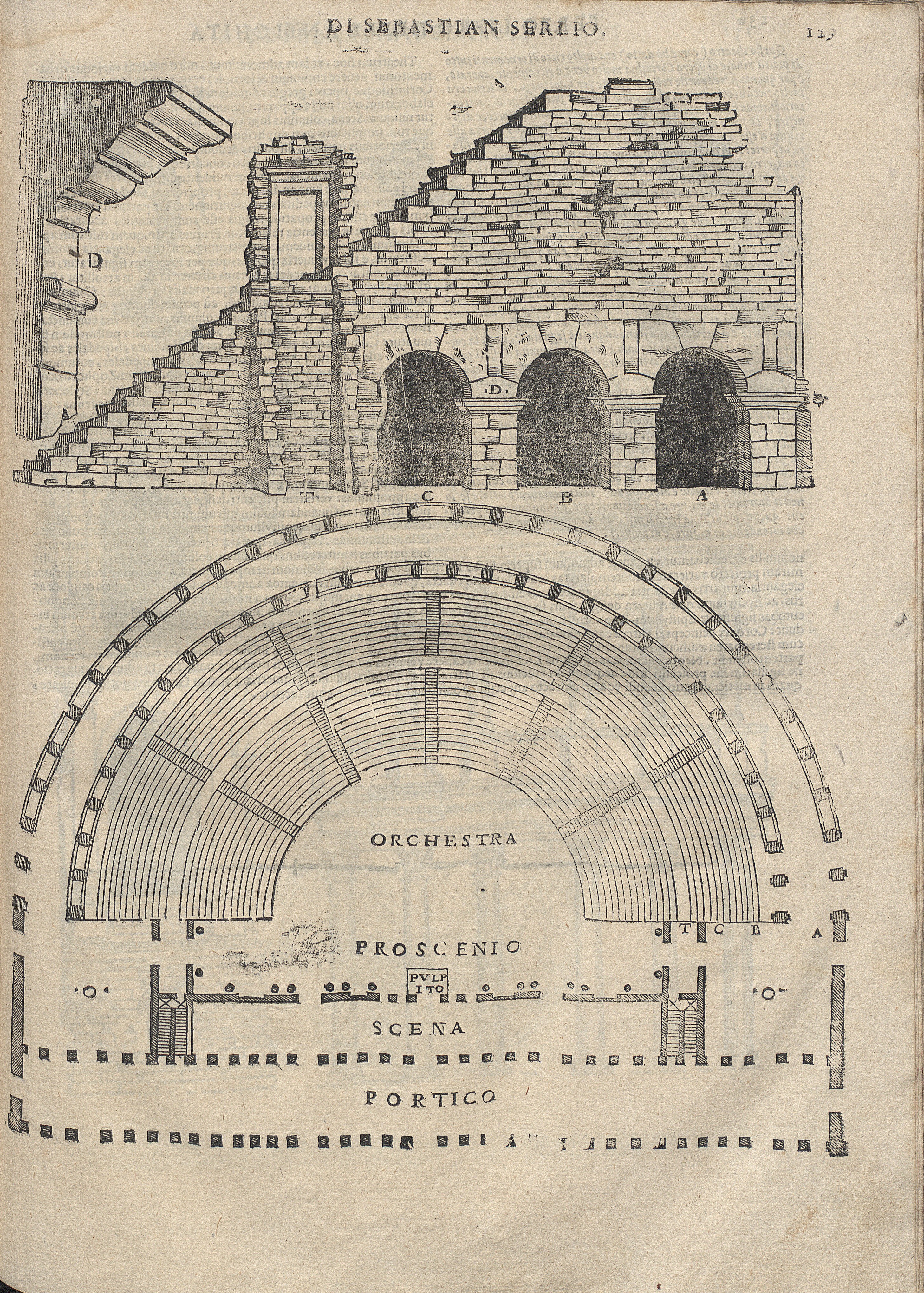
Adding a second dimension, these columns are intersected with rows, so that in ascending order each column becomes split into seven parts. In this way, every part of the hemi-cycle is denoted by unique, identifying coordinates. While the columns are named after the seven planets of classical astrology, the rows represent the seven days of Creation, or seven degrees that go from unity to plurality, and are named after figures or episodes of classical myth. The first degree does not have a name, and in it each planet is described in its more essential character, through astrological and mythological associations, as well as through references to the angels and planetary spirits.6 From the second level on, the rows are called: the Convivium (of the Gods), the Cave (of the Nymphs), the Gorgons, Pasiphae, Mercury’s Winged Sandals, and Prometheus. Coming back to the image of the theater, this means that the sitting area is divided into forty-nine parts, each one with a unique name. For instance, saying that a place is “under Mercury, in the Gorgons” means that it is in the second “column” or sector, and in the third row from the bottom up.
Finally, alongside his description of this system of coordinates, Camillo offers a set of instructions of what type of information should be placed in each sector of the theatre. Essentially, the content is already suggested by the literary, astrological, and philosophical associations of the planet and figure that are inscribed in the coordinates. For example, he writes that all knowledge pertaining to the technical arts that take place on the waters or that have to do with water should be placed under the Moon, in the degree or row of Prometheus, because the Moon has strong associations with the aquatic element, and Prometheus represents all artificial instruments and tools made by humankind. Additionally, the same contents can become charged with different meanings based on their position in the columns and rows of the theatre. Thus, the theatre is not only a tool to store and retrieve information, but also to explore knowledge more deeply, being led by the powerful associations provided by the planetary columns and by the literary references of the rows. In this way, the theatre crowns the ambitions of both the ars memoriae7 and the ars combinatoria8, helping its user retain information and produce new knowledge.
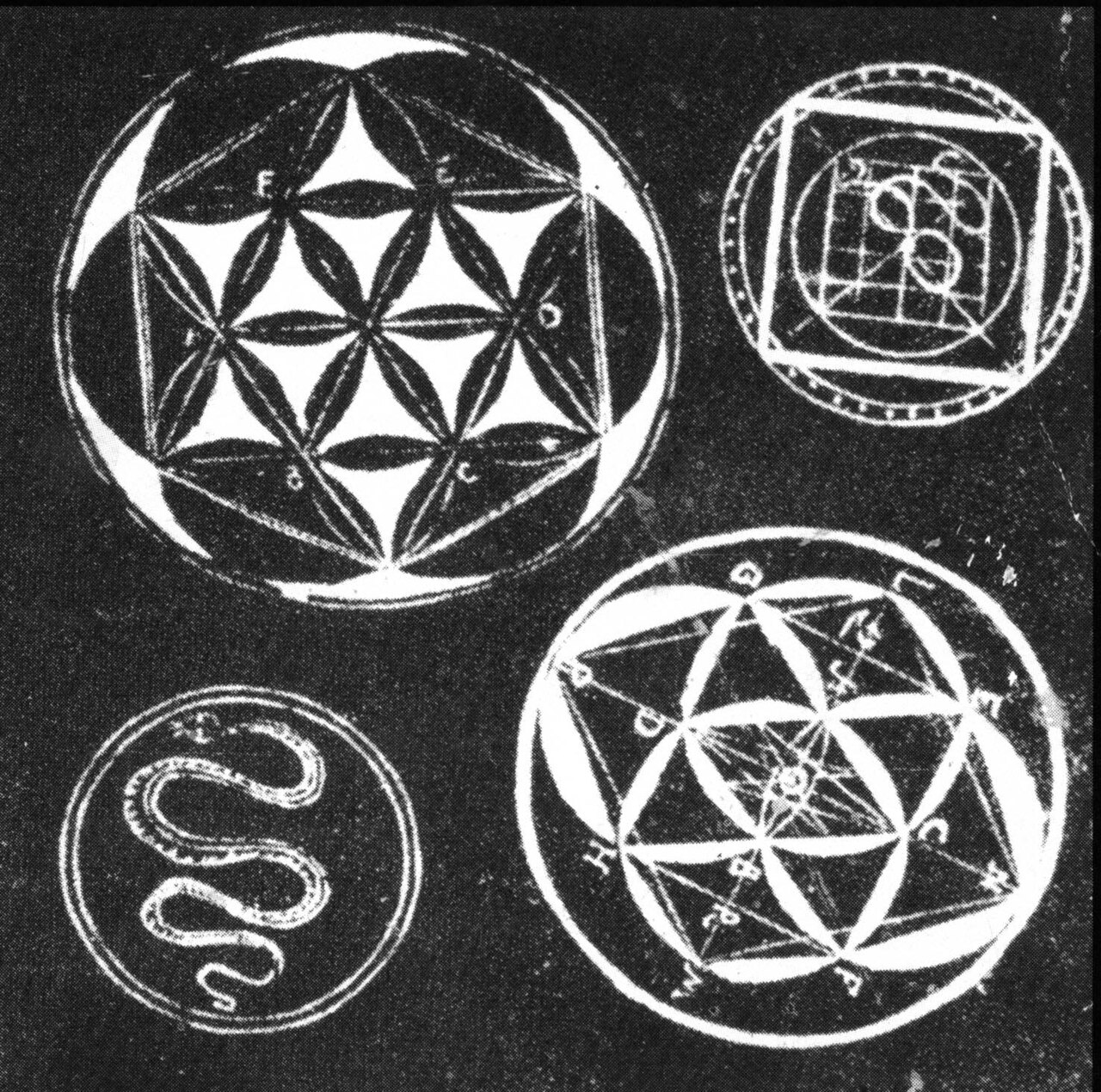
Decades after Camillo, Giordano Bruno also worked on mnemotechnics. His Ars Memoriae contains many striking illustrations of how symbols and concepts could be arranged as wheels to facilitate memorization. In another text, Articuli centum et sexaginta adversus huius tempestatis mathematicos atque philosophos, he uses some of the figures represented here to aid the reader in memorizing his mathematical arguments. However, unlike the instructions of these arts, Camillo’s theatre is not an imaginary scheme that has to be memorized to gain special insights. Instead, the author is rather specific about the tangible materials that would be involved in this project, even specifying what parts of the theatre would have to be painted, decorated with statues, with armillary spheres, or filled with bound books. If one takes the text at face value, the Theatre was not a space to imagine, but a project to build.
How did the theatre work to create knowledge?
Camillo’s theatre is a device that distinguishes between a structure, the contents stored within this structure, and the operations that can be performed on them. How does it work then? To Camillo, the human mind can go beyond individual subjects, and attempt to become broad enough to embrace the whole universe. However, at that point it discovers its limitations. To illustrate this situation, Camillo uses the metaphor of a person standing at the level of the ground in a forest, who is unable to see all the individual trees.9 The theatre, in this case, is like a hill, which offers an elevated point of view and empowers the human mind to see things from a higher perspective. To a greater extent, Camillo writes that the theatre can even bring the human mind above the Earth, and higher still beyond the skies, because its structure reproduces the order of creation and revelation. For instance, its grid of forty-nine collocations imitates Moses’ seven times seven ascents to Mount Sinai.10 Thus, the theatre works as a material implement designed to encode both the order of nature and the inspiration of the divine, so that all knowledge might become perfectly visible to the human mind, unimpeded by the obstacles that it would find on Earth. It does not only allow its user to store knowledge, but also eventually to gain access to all knowledge, because each collocation reveals the correct position of a topic in the archetypal design of the universe.
What the theatre cannot do, however, is to go beyond this system of coordinates. It cannot achieve a type of knowledge that is so beyond what is presently known that there is no position for it. This might have been a crucial fault for someone who disagreed with Camillo in matters of cosmology and epistemology, like most would do today. On his part, however, Camillo chose this set of coordinates with the exact purpose to contain all degrees of being and all aspects of creation in their range. There simply was no possible knowledge, in his view of the structure of the universe, that did not have its assigned place in this design. Camillo’s theatre, in short terms, functions as a heuristic tool to elevate the human perspective, and it is designed based on Camillo’s commitments to a syncretic form of hermeticism, Christianity, and Neoplatonic philosophy.
A second weak point in Camillo’s design is represented by the same critiques that were addressed to the convoluted instructions of the manuals of mnemotechnics, even if the theatre was a project for a material space: that it did not deliver on the promises made, offering a convoluted design that could only lead to a repetition, not a production, of knowledge. This, however, appears to be a pointless argument, as the two opposing factions, the advocates of ars memoriae and their detractor, never genuinely reached a consensus on what may be classified as “new knowledge”. For Camillo, knowledge is not produced, but attained by acquainting the human mind with the superior order of things, which is precisely what the theatre is supposed to do.
Knowledge, creativity, and authorship
The structure of the theatre reveals a precise idea of the role of the author in the production of knowledge, alongside Camillo’s commitments to a humanist form of hermeticism. Indeed, if knowledge is not produced but revealed, then the works of an author have no intrinsic value in themselves, save for the fact they hint at truths already present in the correspondences that run through creation, which the theatre represents with its columns and rows. Camillo seems to have adhered to such an understanding of authorship, however not without some difficulty, and not without the need to explain his position and to defend it against potential critiques, which is precisely one of the functions of his treatise Dell’Imitazione. In this text, Camillo argues that for every form of knowledge there is a perfect model. For instance, Cicero’s writing represents what is most perfect in Latin prose, and the best writing is bound to follow his example in language and style. However, Camillo feels the need to state that imitating is not stealing, and that employing an author’s language is different from intellectual theft (the difference between “usufruttuarii”, users, and “manifesti ladri”, blatant thieves).11 Indeed, Camillo states that the correct attitude is that of the bees, who collect something that they did not create but shape it through their means in a way that fits their goals.12 Likewise, in the theatre literary passages, images, and quotations are fragmented and separated, the role and the choices of their authors disregarded in light of Camillo’s radical process of knowledge re-classification. This points to the aforementioned understanding of the sources, which are valuable only as hints that direct to a fixed, immutable, hidden knowledge.
Camillo’s theatre was constructed as the perfect tool to reveal the deeper truth of things. Today, few would accept the eclectic philosophical premises on which it stands. Fewer still would commit to Camillo’s views about the structure of the cosmos. It would be anachronistic to use the theatre to answer contemporary questions about intellectual property and artificial intelligence. However, contrasting today’s situation with Camillo’s device is useful in at least two ways.
First of all, when it comes to the ambition of creating implements to aid humans in their thinking activities, Camillo’s theatre points to the fact that using tools raises questions of authorship for thoughts just as it does for tangible material creations. Furthermore, it shows that based on their relationship to their sources, thinking devices can simply be tools to imitate, rather than to create new knowledge, and so they strongly depend on the sources they look up to, be they Cicero or any other author taken as a model.
References
- For a critical reading of Benjamin’s 1935 “The Work of Art in the Age of Mechanical Reproduction”, see Miriam Hansen, “Benjamin, Cinema and Experience: ‘The Blue Flower in the Land of Technology’,” New German Critique 4 (1987), 179–224, https://doi.org/10.2307/488138.
- The most recent edition, with a detailed critical introduction is Giulio Camillo, L’idea del theatro. Con “L’idea dell’eloquenza”, il “De transmutatione” e altri testi inediti, ed. Lina Bolzoni (Adelphi, 2015).
- Prisca theologia, litt. ancient, previous theology, is a doctrine according to which the thread of a single theological-philosophical truth has been woven through all major religious, mystical, and philosophical schools from the deepest antiquity to the revelation of Christianity. In such a way, Egyptian religion, the Chaldean Oracles, Zoroastrianism, and the classical myths of Greece and Rome were put in continuity with Hebrew esotericism (especially Kabbalah) and Christianity. It rose to a certain prominence in 15th century Florence where it was associated with figures such as Marsilio Fincino and Pico della Mirandola. More than a single theory, it constitutes a syncretic approach to the interpretation of ancient sources: profound differences can be found between the positions of different humanists who shared a commitment to this view.
- To understand the context in which mnemonic devices were used as legitimate instruments in the construction of knowledge, see William B. Ashford Jr., “Natural History and the Emblematic World View,” in The Scientific Revolution: The Essential Readings, ed. Marcus Hellyer (Blackwell, 2003), 130–156.
- Drawing from both classical myth and Jewish Kabbalah together was seen as a legitimate hermeneutic strategy in the philosophical context of prisca theologia. Sephiroth (singular: Sephirah) are ten spheres, or emanations, or attributes which constitute a channel for the divine unity to manifest itself in a radiant variety that embraces all creation. Sephiroth are described in kabbalistic texts such as the Sepher Yetzirah. They were known even to non-Jewish Renaissance humanists thanks to the translations of scholars like Yohanan ben Yitshaq Alemanno and Flavius Mithridates.
- All planets are described in their fundamental essence on the first row, save for the Sun for which the first and the second rows are switched. Camillo explains that this decision has been made to place the variety and diversity (“latitudine” in Italian) of creation in the most noble place of the theatre, in the central column (Sun), in the first row, cfr. Camillo, L’idea del theatro, 155.
- The art of memory, that is the set of doctrines centered on mnemotechnics that illustrate how to train one’s memory to achieve the goal of memorizing large bodies of knowledge.
- The ars combinatoria before its algebraic formalization indicated a set of techniques aimed at translating knowledge into a symbolic form and then, by operating on the symbols, to combine them in ways that let the operator achieve new knowledge. A century after Camillo, this approach was explicitly criticized by Descartes in his Discourse on the Method, while Leibniz instead attempted to develop it in his pursuit of a universal language.
- Camillo, L’idea del theatro, 151.
- As Lina Bolzoni observes in her detailed introduction, Camillo here comes dangerously close to suggesting a re-creation of the world, cfr. Camillo, L’idea del theatro, 9–138.
- Giulio Camillo, Opere (Farri, 1544), 197–232. This text lacks a recent critical edition but is accessible on Google Books, https://books.google.de/books?id=8SQwPUWafO8C&pg=PA1&hl=de&source=gbs_selected_pages&cad=1#v=onepage&q&f=false.
- When he uses the bees as a metaphor for the production of knowledge and the manipulation of text, Camillo joins a long tradition starting from classical antiquity. A former example of this metaphor which is especially famous appears in Seneca’s Letter 84. See also Margaret Graver, “Honeybee Reading and Self-Scripting,” in Seneca: The Literary Philosopher (Cambridge University Press, 2023), 262–283, https://doi.org/10.1017/9781316683125.018.
SUGGESTED CITATION: Pigato, Francesco: Artificial memory, artificial thought. Giulio Camillo's Idea del Theatro between imitation and creativity, in: KWI-BLOG, [https://blog.kulturwissenschaften.de/artificial-memory-artificial-thought/], 20.05.2026