Awe Studies, and the Neutering of a Complex Emotion
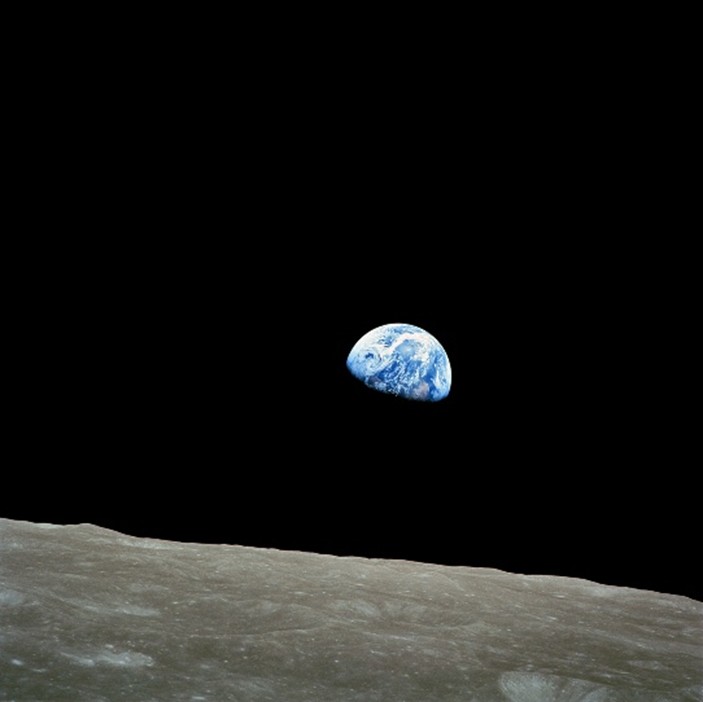
Consider the photo Earthrise (1968). In the foreground, a dull landscape that looks almost artificial in its alien, grey-brown porosity: a close-up of dry skin in a cosmetics advertisement. Serenely hanging above, however, small, yet stealing the scene, is a body in partial eclipse: a brooch pinned to black satin, its lower third fuzzed by deep shadows. It is blue, though most of that blue is obscured by trails and beadings of white. Seemingly radiant with its own light, it glows as a beacon in a sea of perfect darkness.
It is the Earth, pictured, so it seems, from the moon. Compositionally, the photo has the vibe, we could say, of a holiday snap, in that the Earth is not centred, nor particularly large in the photo, with what seems to be about three quarters of the entire picture taken up by the absolute blackness of space. It has been rendered small: smaller than the strangely inconsequential foreground of the Moon. It is indeed the Earth, rather than that alien, cratered landscape, that looks strange, or which must have done so to those seeing it like this for the first time. Earthrise was the first photo depicting the Earth rising, as the moon and sun do from an earthly perspective.
I often display this picture when I give talks on awe. Even though I am a literary scholar, and my research is more fully focused on how narratives arouse this emotion, Earthrise has proven a perfect fulcrum with which to crowbar awe into the room, to summon the emotion rather than merely describe it. Earthrise is well suited not just because of its spectacularity – the first view of the Earth from this perspective, the scalar reversal of the planet and its moon, the rounded beauty of the former and its almost-moving marbling of clouds – but because it also captures the complexity of awe, which is to say that it is not just beautiful, it is also, in an older sense of the word, terrible. Terrible and dangerous beauties have for a long time been associated with the emotion – the mountaintop, the cliff-face, the waterfall, the never-ending expanse of a desert, the vacuum of space – to the great interest of philosophers, anthropologists, literary critics, and so on. Why, then, have successive psychological studies of this emotion defined the terrible out of it? Why does the founder of the field of awe studies now insist that awe must, definitionally, feel good? And what can this tell us about our disciplinary cultures, and their tolerance for complexity?
Earthrise was taken in 1968 by the astronaut William Anders on the Apollo 8 trip. While actually taken in orbit of the moon rather than from its surface, the photo gives the impression of standing on that cratered landscape and craning up to see one’s home planet – one’s entire world – shrunk to a bauble. This perspective inculcates, certainly, a sense of wonder. One can extend this wonder by thinking about, say, the billions of lives teeming on that speck; the grand history of science and technology, and the path from ships to spaceships; the massed efforts and intellects required to get that cameraman off planet and then back again; the estimated billion people training their eyes and ears on updates from this miniscule capsule.
But might this wonder wobble when we extend these meditations further? Slip into Anders’ viewpoint and consider what it must feel like to be stuck in a small pocket of air endlessly pushed-upon by air’s engulfing absence. Consider what it must feel like to be the only humans, living or dead, not on planet Earth: to know that your return to this world relies on the exact and correct procession of millions of lines of mathematics. And might we, as Anders, sardine-packed in a too-small tin, think back some two years to the Apollo 1 mission, when some equation somewhere went wrong, resulting in a flash fire during a launch-pad test that trapped and killed three colleagues?
The complexity of experience that both Anders’ story and Earthrise can arouse will be familiar to many of us as the sublime. Most famously accounted by Edmund Burke in A Philosophical Enquiry into the Origin of Our Ideas of the Sublime and Beautiful (1757), the affect of the sublime is typically understood as an experience of intense awe, typically at something that vastly exceeds us in scale or power, and often tinged, even doused, with fear. Burke argues that:
Whatever is fitted in any sort to excite the ideas of pain and danger, that is to say, whatever is in any sort terrible, or is conversant about terrible objects, or operates in a manner analogous to terror, is a source of the sublime; that is, it is productive of the strongest emotion which the mind is capable of feeling.1
These pains and dangers do not need to be physical: we may experience the sublime on entering a cathedral, say, with no fear for our safety, but feeling, all the same, overwhelmed by the scale of the building and what it represents. For believers, the intensity of such a feeling could be well sharpened by a fear of damnation.
While rooted in understandings such as Burke’s, the psychological field of awe studies has consolidated the sublime, wonderful, terrible, awesome and awful into the emotion of awe. Uniting these reactions into awe emotions is the fact that awe is fundamentally a reaction to scale. Awe’s elicitors are typically objects, ideas, and consequences of size, complexity, and interconnectedness, while the resulting emotion is typically felt as full-bodied, stalling us in, say, shock, amazement, or wonder. Awe thus emerges from an enlarging or opening of the mind to possibility. As such, awe has been categorised as an epistemic emotion: one of the emotions that regulates our attitudes to knowledge.
We may experience awe upon seeing a sunrise, on witnessing a superhuman feat, or in contemplating something of great complexity such as a mathematical equation. We may even find it in the opposite end of the scalar: in the microscope’s revelation of a new world beyond the visible, vast in its minusculity. Awe characteristically makes us feel small, and more connected to others. This may be positive, emerging, say, from the sunrise on a mountaintop, which reaffirms the vastness of the world and our place within it. By Burke’s understanding, however, this experience may also be dreadful: making us, and our accomplishments, feel insignificant in the face of such vastnesses. As understood through this lens, awe can make one feel both hopeful and hopeless, based on whether we feel empowered or overwhelmed by the world to which we are intricately connected.
Such descriptions of awe – or its analogous or contained emotions – can be found well before the psychologists began to quantify it, attempting to distil these complex experiences in order to identify their most basic, necessary, or important element. Indeed, the defining definition of awe did not emerge from the delineated data of questionnaires, nor from graded biochemical or electrical responses to stimuli. Rather, it came from readings in the humanities. In their field-defining 2003 article, “Approaching awe: a moral, spiritual and aesthetic emotion”, Dacher Keltner and Jonathan Haidt open by noting that few emotion theorists then considered awe in their taxonomies.2 In seeking a definition of the emotion, they thus find themselves largely dependent on spiritual, sociological, and philosophical accounts of the emotion. The constellation of points by which they give shape to awe includes both the divine ecstasies of Arjuna in the Bhagavad Gita – who, having been gifted with a god’s eye view of the universe, trembles with ecstatic, fearful joy – and the conversion of Saint Paul on the road to Damascus, and the light from heaven which blinded him for three straight days. It also includes the work of Weber on the awe exerted by charismatic leaders, who bend others to their will; and the work of Durkheim, and the emotions of collectives – societies and nations – that simultaneously subordinate the individual while making them feel part of something larger than the self. And, naturally, Keltner and Haidt draw on Burke, whose sublimity – its edge sharpened by displays of power, and its threat made mysterious by obscurity – informs the duo’s understanding of awe outside of social spaces.
The definition of awe arrived at through these readings has remained the definitive in the field: a perceived vastness, accompanied by a need to accommodate said vastness into one’s current mental structures. But what have the ensuing twenty-plus years of awe studies delivered, through countless sensory surveys, strictly delineated diaries and lab-elicited emotional states? Is it the quintessence of an emotion, or its simplification?
I argue that awe has been domesticated into a well-being emotion, market optimised so that it can be folded into the good life’s daily regimen of diarying, vitamins, stretches, puzzles, and manifestations. The most egregious actor in this domesticisation is Dacher Keltner’s 2023 pop psychology book, Awe: The New Science of Everyday Wonder. Keltner, the father of awe studies, describes this emotion, once associated with a combined uplift and diminishment, coming-together and oppression, beauty, and danger, as so:
Awe begins in encounters with the eight wonders of life. The experience of awe unfolds in a space of its own, one that feels good and differs from feelings of fear, horror, and beauty.
Our everyday lives offer so many occasions for awe.3
What is most noteworthy here is that awe must now feel good. We might surmise that this new, definitional necessity serves to distinguish awe from the horror and fear that are sidelined in the same sentence. A far cry from the divine ecstasies that informed Keltner and Haidt’s originating definition, awe has now found itself as an everyday emotion. Indeed, it is this necessary everydayness of awe that is pitched as the great secret offered by this book, one uncovered by Keltner’s lifelong research into the good life. Awe, it seems, has been reduced, rather than distilled, into something simple, routineable, and sunnily, permanently positive.
What, however, of the terror and oppression of awe: the dread that characterised its use – in English – until quite recently? Anticipating such a question, Keltner reassures us that while:
The etymology of the word “awe” traces back eight hundred years to the middle English “ege” and Old Norse “agi,” both of which refer to fear, dread, horror, and terror.
. . . Remember, though, that when “ege” and “agi” emerged in the spoken word some eight centuries ago, it was a time of plagues, famines, public torture, religious inquisition, war, and short life expectancy; what was vast and mysterious was violence and death.4
Not only does 2023 seem a very strange year to insinuate that we have successfully moved beyond plague, famine and war, but this statement alone suggests that awe cannot be definitionally good if the emotion changes according to our experiences.
To understand Keltner’s commitment to defining awe as positive requires us to understand what an emotion is, and the stakes of being an emotion. While now highly contested, emotions have traditionally been considered by psychologists to be basic and limited: the fundamental building blocks of our emotional life. That is, to reach the status of emotion, an emotional experience has to be common to all humans and monovalent, that is, singularly good or bad. By this understanding, emotions must have unique facial expressions that do not differ across cultures, so that a human’s intuitively made “anger” face is the same at all points of history and all corners of the globe. In various combinations and concentrations, like elements in the periodic table, these emotions then form the rest of our feelings, or emotional experiences. By this understanding, awe itself can be argued to be an emotion, whereas dread, say, is a combination of awe and fear; that is, two emotions experienced at once.
It is beyond this literary critic’s authority to comment on the biomechanics of this: that is, to untangle the actual embodied difference between an understanding of dread as a negatively valenced awe or as a co-occurrence of awe and fear. What I can comment on, however, is how disciplinary and institutional structures structure knowledge. Rhetorically, the distinction between these two accounts of awe does not, in itself, explain the psychologists’ decomplexifying of awe: the justifying interest of such scholars is not in the exact bodily mechanics by which awe is made, but in the personal and social ramifications of this emotion, the effects of awe on people and societies. We could, graciously, suggest that a focus on proving awe’s monovalence by proving its purely positive nature has merely incidentally led to a research focus on the positive effects of awe, but this seems weak. Rather, it seems that making an emotion of awe adds something to the discipline itself: it makes the object of its study fundamental.
Even if one accedes to an understanding of awe as a purely positive emotion, this does not make awe ethical: it simply makes awe pleasant. While much has been said in recent years about criticism’s tendency toward paranoia – the hermeneutics of suspicion that criticism’s own institutional structures have rewarded and thus spread – such an interpretive stance would not have missed the fact that awe’s power is dangerous. While awe studies emphasises the pro-social and evolutionary benefits of awe – say, in the unifying effect of charismatic leaders – the emotion can clearly play a role in extremism, submissiveness, and blind faith. Indeed, conspiracy, as one of the defining epistemologies of our time, seems to pivot on awe-moments, as in, everything you know is a lie, and the knowledge reorganisation that such a moment may entail.
It is blatantly obvious, for example, that awe is routinely weaponised in the rhetoric of contemporary far-right movements, and their conjuring of a perfect, varnished past that has been waylaid by a vast, conspiratorial “deep-state”. Indeed, this understanding of the emotion is core to the works of Durkheim and Weber, from which Keltner and Haidt drew their defining understanding of awe. One could easily obey Keltner’s good-life tenets by attending MAGA rallies and allowing oneself to be whipped into a hypernationalist fervour: the awe that one might experience there may well, as the various studies conducted and cited by Keltner suggest, help one sleep, reduce inflammation, lower stress, aid digestion, and ultimately extend one’s life.5 Keltner may, by no means, expect one to seek awe in such a place, but it would yet fulfil the positive effects of positive emotions. Such cases do not get any attention from awe studies: it is ascertaining the pleasantness of this experience that seems to be the discipline’s current keystone. What about awe, then, as it matters: when it is unleashed into the real world? Let us return to the image with which I opened this article.
As beautiful and arresting as Earthrise would prove to be, the shrinking of the Earth – the pictorial revelation of both its astral insignificance and ark-like significance – also roused emotional shifts and crises in the lives of its inhabitants. Anders, the photographer, credited the experience as dissolving his religious beliefs. Reflecting on the photo fifty years after its taking, he exclaims that “the idea that things rotate around the pope and up there is a big supercomputer wondering whether Billy was a good boy yesterday? It doesn’t make any sense.”6 The epistemic weight of an awe experience is easily felt here. We must also remember that emotions are ethically neutral, and negative emotions may accomplish good things. Through the smallness with which Earthrise depicts the planet, the Earth also becomes fragile: a spaceship in a lifeless, portless sea. The successful use of Earthrise by environmental movements can perhaps be traced to the dread that this can arouse: drawing dramatic attention to our need to protect this singular blue oasis in a clearly deserted darkness.
References
- Edmund Burke, A Philosophical Enquiry into the Origin of Our Ideas of the Sublime and Beautiful (printed for R. and J. Dodsley, 1757), 36.
- Dacher Keltner and Jonathan Haidt, “Approaching awe: a moral, spiritual and aesthetic emotion”, Cognition & Emotion 17.2 (2003), https://www.doi.org/10.1080/02699930302297.
- Dacher Keltner, Awe: The New Science of Everyday Wonder And How It Can Transform Your Life (Penguin, 2023), 26.
- Ibid., 19.
- Many such benefits correspond with the lowering of cortisol, the stress hormone. See Maria Monroy and Dacher Keltner, “Awe as a Pathway to Mental and Physical Health”, Perspectives on Psychological Science 18.2 (2023), https://www.doi.org/10.1177/17456916221094856.
- Ian Sample, “Earthrise: how the iconic image changed the world”, The Guardian (2018), https://www.theguardian.com/science/2018/dec/24/earthrise-how-the-iconic-image-changed-the-world.
SUGGESTED CITATION: Kavanagh, Ciarán: Awe Studies, and the Neutering of a Complex Emotion, in: KWI-BLOG, [https://blog.kulturwissenschaften.de/awe-studies-and-the-neutering-of-a-complex-emotion/], 16.11.2026