Geopolitics and Aesthetics
The word “geopolitics” means many things, but here I will be using the term in the context in which it first appeared: as a school of thought conceived to systematically manage territorial space, and to justify imperialism and white supremacy. Friedrich Ratzel, one of the founding figures of geopolitics at the turn of the twentieth century, posited that countries were like living beings that had to constantly look for what he called lebensraum, more space into which they could expand to gain more power and resources and thus ensure their survival.1 According to the historian Enzo Traverso, this concept was popularized by “the völkisch writer Hans Grimm [in] a novel titled Volk ohne Raum (A People Without Space)”.2 Geopolitical thinking in this era insisted upon what the geographer Gearóid Ó Tuathail calls “a visual and aesthetic organization of…the dream of a ‘total view’”3 of the globe, and its fundamentally racist framework sought to “manage” European colonies and scientifically justify “the superiority of the white European races and the naturalness of imperialism”.4
Although the idea of lebensraum was discredited in Europe following World War II,5 geopolitical expansionism is key to thinking about Latin American authoritarianism, just as it was foundational to Nazi tactics of “[d]eportation, dehumanization, and racial extermination”.6 The lebensraum thesis played an important intellectual and legitimating role in the South American military regimes of the 1970s and 80s,7 although this form of seeing territory – from a perspective that Jens Andermann calls the “optic of the state”8 – was prevalent in the region since its 19th-century genocidal campaigns of territorial expansion. Military geopoliticians in Latin America – particularly in Argentina, Chile, and Brazil – sought to justify the expansion of their respective countries into increasingly peripheral areas, in order to extract natural resources, despoil indigenous people of their land and knowledge, and preserve the integrity of national borders from foreign enemies, whether imagined or real. This was the crux of Augusto Pinochet’s volume Geopolítica de Chile (1968), for example.9 The authoritarian imaginary of Latin American culture idealizes the peripheral territories of the region – Patagonia, the Falkland Islands, the Chaco region, the Atacama Desert, Easter Island, and Antarctica – as a terra nullius, that is, “deserted” spaces (in the words of the critic Javier Uriarte10) into which states could expand their sovereignty and combat perceived colonial threats from their neighboring countries, as well as from Europe.
In Latin America and elsewhere, there is a long history of allegorizing geopolitics. South American dictators, like the Nazis before them,11 represented their enemies as cancer cells to be eliminated for the good of the body politic.12 Corporatist and fascist thinkers in the Chilean military figured the heterosexual family as a stable, organic unit that grew in similar ways to their idea of the expansionist state.13 In his recent book Somatic States, Franck Billé shows that the affective charge of geopolitical metaphor comes from “cartographic anxieties”14 about the ability of maps to reflect countries’ political geography. Speaking about “national DNA,” or figuring Brexit as a quasi-emotional “breakdown” for Europe, or talking about lost territories (Crimea, for example) as “phantom limbs”,15 make bodies and states commensurable, and thus solidify certain metaphors into nationalist discourses, which often have masculinist, antisemitic, homophobic, and racist overtones. We can see, then, that Fredric Jameson took on an important and necessary task when he decided to analyze the allegorization of geopolitics in his seminal text The Geopolitical Aesthetic. In this current moment of entirely justifiable paranoia surrounding the return of authoritarian movements around the globe, it’s worth returning to Jameson’s theories as “an attempt…to think a system so vast that it cannot be encompassed by the natural and historically developed categories of perception with which human beings normally orient themselves”.16 Deriving a kind of “cognitive map”17 of these systems – revealing connections among different geographic and linguistic syntagms – offers, for Jameson, the possibility of revealing a conspirative truth that would otherwise remain invisible.
My book project, Cosmic Racisms: Geopolitics, Authoritarianism, and Aesthetics in Latin America’s Southern Cone, argues that geopolitical thinking is key to understanding the specifics of authoritarian aesthetics in Latin America, beyond the European context in which they have been primarily theorized. Identifying the common elements among three different authoritarian moments in the region – the large-scale genocides of indigenous peoples toward the end of the 19th century, the impact of European fascism in the 1930s and 40s, and the dictatorships of the 1970s and 80s – is an aesthetic operation that can help to denounce interlinked patterns of racism, settler colonialism, and genocide in Latin America. My project thus examines texts that draw “imaginative links”18 – to use the terminology of Rothberg’s text Multidirectional Memory – among these different moments of authoritarian expansionism. This aesthetic of linkage, proximity, and closeness both exposes the way authoritarianism has worked in Latin America over time; it also stands in opposition to the ways in which authoritarianism functions to seduce us with its distant, all-seeing, cartographic gaze.
In Latin America, one key motif in the aesthetics of geopolitical expansionism is that of the hand – always that of a man, often from the military – pointing at a map, in a gesture of domination over that “total view of global space”19 described by Tuathail. This kind of gaze is invoked, in a critical way, by the Chilean author Roberto Bolaño in several of his works. In the The Third Reich (2010), for example, the novel’s German narrator Udo Berger is obsessed with a World War II simulation boardgame with the same name as the novel. When playing the game with a character named “El Quemado” (so called due to burns all over his body as a result of having been tortured during an unnamed South American dictatorship), Berger avoids looking at his opponent directly by averting his gaze downward, to the game’s map. The map divides Europe into neat hexagons: “The Burned One shrugged his shoulders and smiled several times, undecisive still. These gestures made his expression uglier, almost to a point where I couldn’t stand it. So while he thought about his next move, I looked down at the map”.20 The preference Udo holds for the more overhead vantage point of Europe becomes part and parcel of his political leanings: he plays the Third Reich side in the game, and his fascist sympathies become increasingly clearer throughout the novel.
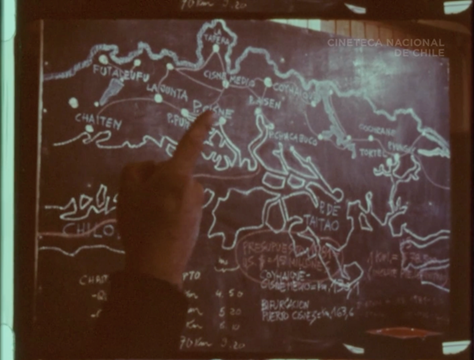
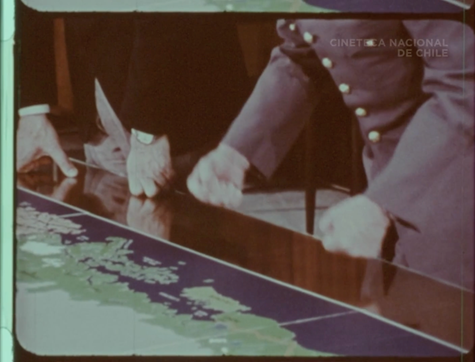
In his work, Bolaño is reckoning in a critical way with gestures of geopolitical domination that have a long history in Latin American cultural production. The 1980 short documentary Destino Austral (Austral Destiny), directed by Vittorio di Girólamo and produced with the support of the Chilean dictatorship (1973–1990), portrays the construction of the Austral Highway, Pinochet’s star infrastructure project, conceived to facilitate settler colonialism in the hostile, fragmented terrain of Chilean Patagonia. In several scenes, military men point to the map of the region, with gestures of dominion over an area whose sense of connectivity with the rest of the country has been viewed as somewhat vulnerable, according to the historian Ernesto Bohoslavsky, given its more recent and somewhat tenuous incorporation into the state.21 The hands on the map offer a sense of prosthetic reinforcement: a “weak” territory’s belonging to the mainland can be strengthened with the assurance of military force, shoring up the authoritarian and nationalistic “destiny” of Patagonia.
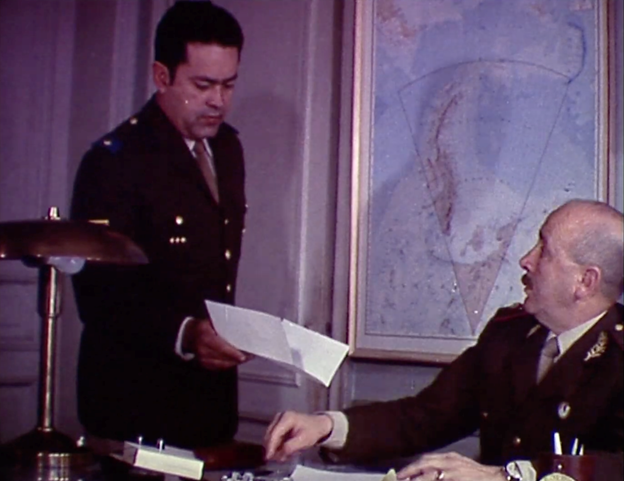
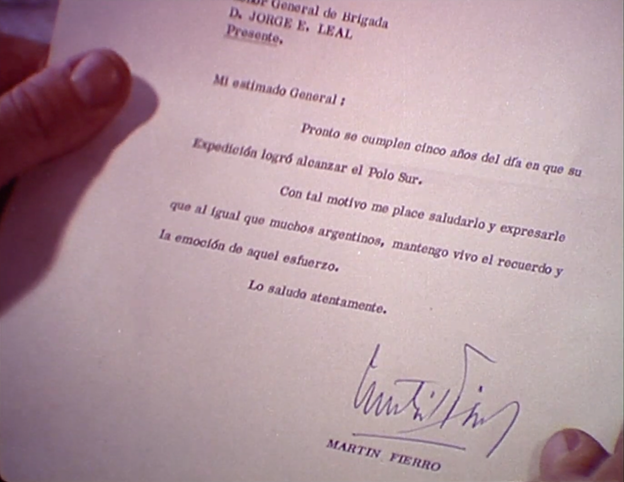
The Argentine documentary short Marcha al límite austral de la patria (1969), meanwhile, commemorates the military’s first overland expedition to the South Pole, in 1965. Here, the filmmakers appropriate the literary genre of the gauchesque – a traditional form of heroic, epic poetry about the gauchos of Argentina’s hinterlands, which contributed to the founding myths of the Argentine nation – to tie the military’s “conquest” of Antarctica to previous state occupations of lands inhabited by indigenous people. The film shows General Jorge Leal, who led the South Pole expedition, receiving a letter of congratulations supposedly signed by Martín Fierro, the main character of José Hernández’s eponymous 1872 gauchesque poem. The implication is that Leal is a sort of modern-day gaucho, a pioneer in the “Argentinization” of the so-called “white continent”.
In the face of these gestures of geopolitical domination involving references to distant maps of territories to be exploited, other anti-authoritarian forms of thinking function to create “new communal and political identities”22 that denounce a cultural history of systematic racism, authoritarianism, and genocide across multiple temporalities. A major critical aim of Edward Said’s Culture and Imperialism (1993), for example, is to think about colonialism “in other than compartmentalized terms, so as to transform our understanding of both the past and the present and our attitude toward the future”.23 In this way, Said recuperates imperialism’s considerable shadow24 over the European literary tradition in the present, but also examines how postcolonial elites “felt the clear need to project their power backward in time” such that their acquisitions had “a history and legitimacy that only tradition and longevity could impart”.25 Connecting multiple temporalities to one another is a key anti-imperialist critical gesture, Said reminds us.
Another way of making these connections across time is through the field of genocide studies, which hinges upon comparing different instances of genocide to theorize about what constitutes it and what does not. Scholars and activists do this so they can denounce genocide with greater clarity, particularly when others deny that a particular event is genocidal, as has historically been the case with the Argentine state vis-à-vis its crimes against the humanity of indigenous peoples.26The historian Daniel Feierstein (2014) addresses genocidal parallels between the Nazi Holocaust and the Argentine dictatorship. Highlighting the continuities between these two genocides allows him to deploy Holocaust consciousness as a “platform”27 for articulating other histories.
Meanwhile, new approaches to geopolitical thought, from a feminist perspective, also offer ways of critiquing the authoritarian, masculinist foundations of genocide and expansionism across multiple distances and time scales. The idea of the cuerpo-territorio, or body-territory, has emerged out of large-scale feminist social movements in Latin America to legalize abortion and legislate the crime of femicide, and offers a new approach to anti-authoritarian geopolitical thinking that can be traced back to at least the 1990s. According to the Argentine political scientist Verónica Gago, the concept of cuerpo-territorio
explains the structure of neo-extractive exploitation of territories, which reconfigure the exploitation of labor, mapping the consequences produced by the dispossession of common goods in daily life. It is therefore strategic in a very precise sense: it expands a way of ‘seeing’ from the perspective of bodies that are experienced as territories, and of territories experienced as bodies.28
Here, Gago articulates the cuerpo-territorio concept in the same terms of geography and expansion that we saw in the work of Tuathail and Jameson, but also departs from it, taking a much more proximate, multisensory, and haptic approach. In her attempt to articulate collective forms of struggle against patriarchy, Gago figures the geopolitical concept of cuerpo-territorio in terms of connectivity across multiple places and people and recuperates the very ideas that the genocidal states of Chile and Argentina sought to eradicate in the name of extractivist “development.”29 Indeed, the cuerpo-territorio concept draws heavily from the knowledge of indigenous thinkers such as Berta Cáceres, the lenca leader assassinated in Honduras in 2016 following her advocacy against environmental depredation in the area, the sociologist Silvia Rivera Cusicanqui in Bolivia, and the Mapuche leader Moira Millán from Argentina.
These multiple theoretical approaches to connective thinking offer an alternative to the authoritarian ethic of distance, denial, and disconnection that we see in the military short films; Bolaño’s writing denounces this, as do feminist works such as Lucía Puenzo’s film and novel Wakolda (from 2014 and 2011, respectively), works tied to memory studies like Esteban Buch’s El pintor de la Suiza argentina (The Painter of Argentine Switzerland, 1991), and even speculative fiction like Michel Nieva’s La infancia del mundo (Dengue Boy, 2023). Despite coming from different disciplinary angles, Said’s anti-imperial literary criticism, the sociological and historical approaches to genocide studies of Feierstein and Rothberg, and Gago’s feminist political theories all show us how to read other ways of creating new connections across different historical moments, bodies, and cultural genealogies that can combat authoritarian expansionism – so tied to masculinity and coloniality – from a particularly Latin American perspective.
References
- Klinke, Ian (2023): Life, Earth, Colony: Friedrich Ratzel’s Necropolitical Geography, Ann Arbor: University of Michigan Press, pp. 2-3, https://doi.org/10.3998/mpub.11987710.
- Traverso, Enzo (2003): The Origins of Nazi Violence, trans. Janet Lloyd, New York: The New Press, p. 53.
- Tuathail, Gearoid (1996): Critical Geopolitics: The Politics of Writing Global Space, Minneapolis: University of Minnesota Press, p. 34.
- Ibid., p. 23.
- Howkins, Adrian (2017): Frozen Empires: An Environmental History of the Antarctic Peninsula, Oxford: Oxford University Press, p. 42, https://doi.org/10.1093/acprof:oso/9780190249144.001.0001.
- Traverso 2003, p. 73.
- Hepple, Leslie (1992), Metaphor, Geopolitical Discourse and the Military in South America, in: James Duncan and Trevor Barnes (eds.): Writing Worlds: Discourse, Text, and Metaphor in the Representation of Landscape, New York: Routledge, pp. 136-154, here p. 138.
- Andermann, Jens (2007): The Optic of the State: Visuality and Power in Argentina and Brazil, Pittsburgh: University of Pittsburgh Press, https://doi.org/10.2307/j.ctv10tq44x.
- Pinochet, Augusto (1968): Geopolítica de Chile, México: El Cid.
- Uriarte, Javier (2020): The Desertmakers: Travel, War, and the State in Latin America, New York: Routledge, https://doi.org/10.4324/9781315618395.
- Feierstein, Daniel (2014): Genocide as Social Practice: Reorganizing Society under the Nazis and Argentina’s Military Juntas, trans. Douglas Andrew Town, New Brunswick/London: Rutgers University Press, p. 49; Traverso 2003, p. 20, https://doi.org/10.26530/OAPEN_625248.
- Tuathail 1996, p. 54.
- Hepple 1992, p. 150.
- Billé, Franck (2025): Somatic States: On Cartography, Geobodies, Bodily Integrity, Durham/London: Duke University Press, p. 2, https://doi.org/10.1515/9781478060703.
- Ibid., p. 10.
- Jameson, Fredric (1992): The Geopolitical Aesthetic, Bloomington: Indiana University Press, pp. 1–2.
- Ibid. p. 15.
- Rothberg, Michael (2009): Multidirectional Memory: Remembering the Holocaust in the Age of Decolonization, Palo Alto: Stanford University Press, p. 18.
- Tuathail 1996, p. 34.
- Bolaño, Roberto (2010): El tercer reich, New York: Vintage Español, pp. 174–175.
- Bohoslavsky, Ernesto (2009): El complot patagónico: Nación, conspiracionismo y violencia en el sur de Argentina y Chile (siglos XIX y XX), Buenos Aires: Prometeo, p. 24.
- Rothberg 2009, p. 11.
- Said, Edward (1993): Culture and Imperialism, New York: Vintage, p. 17.
- Ibid., p. 5.
- Ibid., p. 16.
- Delrío, Walter, et al. (2010): Discussing Indigenous Genocide in Argentina: Past, Present, and Consequences of Argentinean State Policies toward Native Peoples, in: Genocide Studies and Prevention: An International Journal vol. 5, no. 3, pp. 138–159, here p. 146, https://doi.org/10.1353/gsp.2010.0010.
- Rothberg 2009, p. 3.
- Gago, Verónica (2019): La potencia feminista, Madrid: Traficantes de Sueños/Tinta Limón, p. 96.
- Ibid., p. 97.
SUGGESTED CITATION: Fischer, Carl: Geopolitics and Aesthetics. The View from Latin America, in: KWI-BLOG, [https://blog.kulturwissenschaften.de/geopolitics-and-aesthetics/], 27.10.2025