Towards an Ecology of the Public Sphere
Spheres and Space
The concept of the public sphere is frequently conflated with that of a space. This conflation is not confined to popular discourse; it also recurs in academic circles. The association, though, is unsurprising: the word sphere readily evokes spatial associations – globes, domains, zones, even bounded arenas.1 Yet this spatialization is not inherent to the concept itself. Rather, it is a product of translation.
The concept of the public sphere originates with Jürgen Habermas, whose 1962 book Strukturwandel der Öffentlichkeit. Untersuchungen zu einer Kategorie der bürgerlichen Gesellschaft developed the concept in the context of Enlightenment Europe. Habermas’s Öffentlichkeit was not a space or place, but a kind of discursive network in which people talk, debate, and reason about public matters – matters in which they have interests and matters that affect them all. Of course, these discourses unfolded in various spaces. In Habermas’s study, such spaces were salons and coffeehouses where the discourse was often mediated by various forms of texts, such as early newspapers, pamphlets, and other literatures. But the key to the concept wasn’t where or how discourse unfolded – it was the discourse.2 The book was translated and published in English in 1989 under the title The Structural Transformation of the Public Sphere: An Inquiry into a Category of Bourgeois Society, popularizing the concept of Öffentlichkeit as “the public sphere” in scholarship and, eventually, in the public sphere itself.
As Michael Warner has pointed out, the spatial sense often attached to the public sphere emerges from the English translation of Öffentlichkeit, which is more closely related to “openness” or “publicness” but lacks the spatial metaphor.3 Once Öffentlichkeit was rendered as “the public sphere,” things started to get spatial. In English, the term “sphere” inadvertently suggests a space or a container, distorting the more abstract relational meaning found in the original German. Imaginations of the public sphere extended to a place you could enter or exit, rather than a process or relationship among speakers as conceived.
The spatial association is evident in digital forums today. On Reddit, for instance, participants often refer to the public sphere as if it were a literal space, collapsing the distinction between public sphere and public space.4 However, instead of dismissing these interpretations, why not ask what they reveal? What if the settings in which the public sphere unfolds are not simply incidental, but imperative for Öffentlichkeit? What if they matter because they shape how we imagine (and misimagine) public life? Expressions like “this is a public forum,” or “that post doesn’t belong in this space,” are often uttered in public spheres, inadvertently treating discourse as architecture. So what if this spatial association isn’t entirely wrong? Why not consider how, where, and amongst whom the public sphere unfolds as influencing what it is?
This is the proposition I want to make: not just what the public sphere is, but why we might want to think about it as an ecology – to think in terms of an ecology of the public sphere, where discourse is inseparable from the conditions and environment in which it unfolds.
Revisiting Habermas
In The Structural Transformation of the Public Sphere, Habermas’s public sphere was constituted of “‘human beings’ engaged in rational-critical debate” and “constituted into one of ‘citizens’ wherever there was communication concerning the affairs of the ‚commonwealth’”.5 For Habermas, it was the bourgeois public sphere of the eighteenth century that “crystalized the idea of ‘public opinion,’”6 placing the origins of his concept in a setting where bourgeois society and print culture were dominant shapers of public discourse. Habermas’s public sphere unfolded in salons, coffeehouses, journals – all spaces where citizens came together to debate public matters. Importantly, these were not necessarily public spaces. Rather, they were settings that enabled a specific kind of discourse: debate oriented around reason, autonomy, and civic responsibility. The public sphere, in Habermas’s account, is not explicitly spatial; it was discursive, and is described as rational, critical, and inclusive.
This is a major point for critique for scholars working with the concept, who – while recognizing its value – call for for a more multidimensional understanding. Nancy Fraser, for instance, has described Habermas’s public sphere as a “historically specific and limited form”.7 Fraser’s critique points out that Habermas’s public sphere is one that presumed a single public, unified by shared rationality and blind to its exclusions of women, the working class, and racialized communities. In reality, she argued, public life has always been fractured; divided by gender, class, race, and access, and marginalized communities have often created their own public spheres. Similarly, Seyla Benhabib has argued that Habermas’s model “proceeds from a fundamental norm of egalitarian reciprocity” connected to a “discourse of domination that legitimizes women’s oppression and exploitation in the private realm,” and needs to be “reconceptualized”.8 Benhabib, like Fraser and other critics, promotes a “dialectical alliance” with the concept, encouraging scholars to engage it critically rather than discard it entirely.
In defense of Habermas, and to qualify the concept, Warner has pointed out that the use of the singular and definite term, “the public sphere,” represents “an imaginary convergence point that is the backdrop of critical discourse”.9 Warner also adds the key dimension of translation in qualifying the concept. By identifying the spatial distortion introduced through translation, he helps us see the public sphere as a “relation among strangers” structured through discourse rather than a literal space.10 The term “the public sphere,” thus, refers to an ideal of a network of discourse linked by shared attention to common public issues.
Still, while it might not have been the intention, the concept has become dialectically connected to space. I argue here that the recurring tendency to spatialize the public sphere is more than a mistake, and offers insight into how publics experience discourse as situated, mediated, and embodied. After all, the coffeehouse, the salon, the subreddit – none of them are neutral. They shape who gets to speak, what gets said, and how it’s heard. This is where an ecological framework becomes compelling.
Ecologizing The Public Sphere
So what do I mean by an ecology of the public sphere? Ecology, in its broadest sense, is the study of relationships between organisms and their environments.11 Fritjof Capra has theorized ecological systems through three principles: process, structure, and patterns of organization.12 Ecologies have also been described using the network metaphor, which implies “that every ecology can be understood as nodes that interact among each other through relationships”.13 Given the dimensions of relationships, patterns, networks, and nodes, the term can be usefully repurposed to describe how public spheres function as situated, mediated, and dis/embodied systems of relational exchange.
This would not be the first time “ecology” has been repurposed. In the late twentieth century, media scholars developed the idea of media ecology to account for such dimensions in media systems. Neil Postman proposed media ecology as the study of media as environments, arguing that it took a “humanistic view” of how media environments “make us what we are”.14 Similarly, in her doctoral dissertation, Christine Nystrom defined media ecology as “the interaction of communication technologies, media, and human behavior”.15 Additionally, Bonnie Nardi and Vicki O’Day later conceptualized information ecologies to describe how technologies, practices, and people always function together, in specific places and under specific conditions.16
Applied to the public sphere, the notion of ecology invites us to understand it not as a static or abstract ideal, but as a system shaped by interactions among people, media, and communicative practices oriented around shared public concerns. These ecologies include the environments – whether physical, digital, or cultural – that structure how (and which) individuals engage, participate, and relate to one another. Here, it is crucial to highlight that public spheres are not fixed; they evolve in response to cultural and technological change, shifting sociopolitical contexts, and moments of crisis. Thinking ecologically allows us to see the public sphere as a dynamic, adaptive network. In this sense, an ecology of the public sphere isn’t just the discourse – it’s also what, who, and how the discourse is made possible.
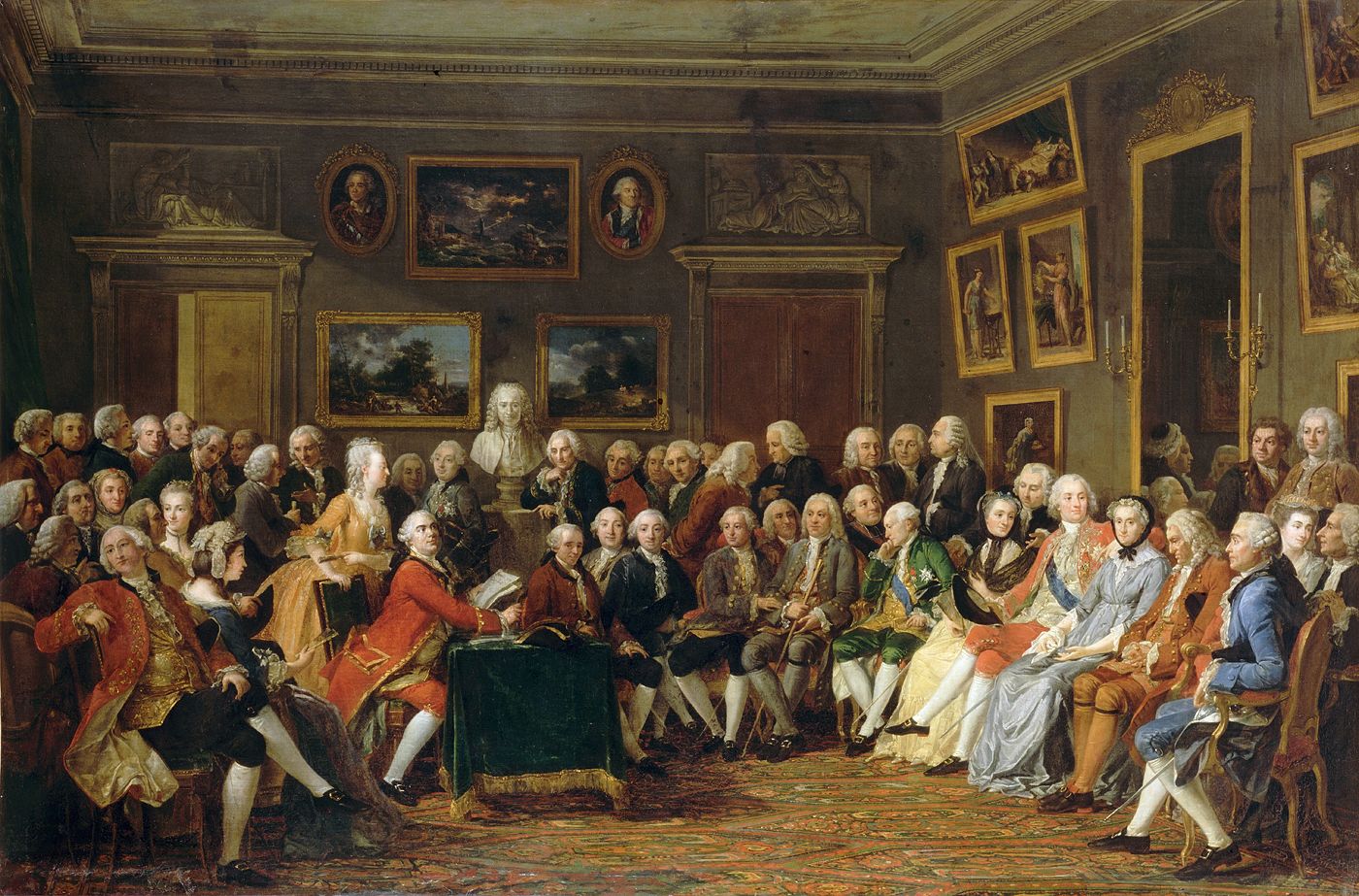
I’ll make this more concrete by revisiting the key examples of salons and coffeehouses invoked by Habermas in The Structural Transformation of the Public Sphere vis a vis representations. One such salon was frequently hosted by Marie Thérèse Geoffrin, a Parisian member of the bourgeoisie and key figure of the French Enlightenment. Geoffrin’s salon in Enlightenment Paris is a classic case of an early public sphere, and in line with Fraser’s critique of Habermas, it was deeply exclusive. Anicet Charles Gabriel Lemonnier’s 1812 painting of Geoffrin’s salon depicts a quintessential Enlightenment scene: men and women gathered around a reading of Voltaire’s Orphan of China. Geoffrin hosted salons with carefully curated guest lists at her home: artists on Mondays, intellectuals and “men of letters” on Wednesdays. These salons were exclusive private spaces, occupied by bourgeois elites.17
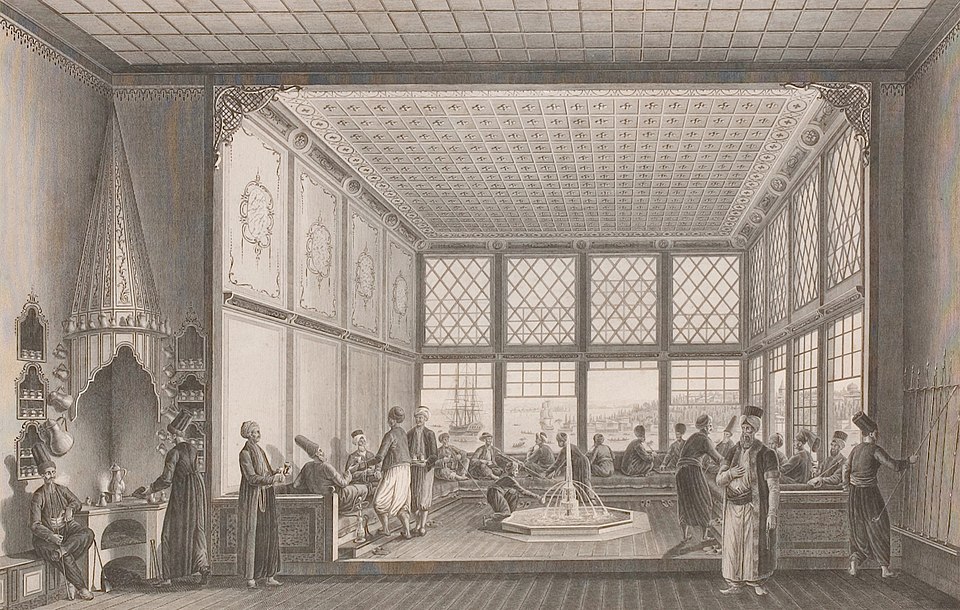
In 17th-century Istanbul, coffeehouses were more socially diverse but still coded by class and gender. Selma Akyazici Özkoçak has described Istanbul’s coffeehouses as socio-religious and commercial centers that seemed to provide a more “civil and sober” environment than local taverns. Coffeehouses were a neutral, accessible space in contrast to the home or the salon, but Istanbul’s grand coffeehouses were intended for wealthier residents.18 Grand coffeehouses in districts like Tophane, complete with views of the Bosphorus, ornamental fountains, and structured seating hosted elite male clientele, often indicated as such by their attire. These weren’t just casual gatherings – they were platforms for news, poetry, and politics. They were also masculine spaces, as women were largely excluded from them.
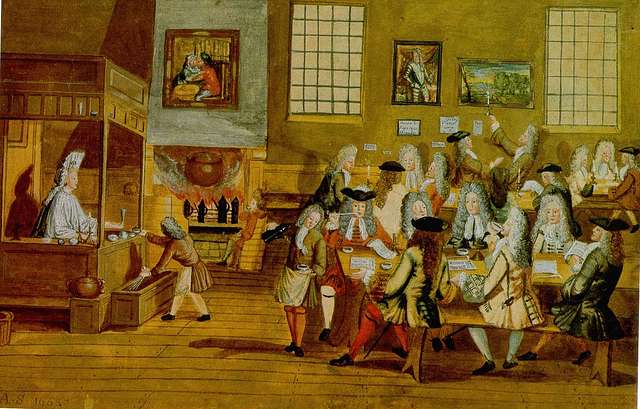
Seventeenth- and eighteenth-century England offered another variant of the coffeehouse as a public sphere. The first London coffeehouse was opened in 1652 by Pasqua Rosée, a Greek servant to a Levant Company merchant, and it quickly became a hub for news, commerce, and debate. By the early 1700s, London had more coffeehouses than any other city in the Western world outside of Istanbul.19 English coffeehouses provided pamphlets and newspapers to patrons along with their coffee, becoming instrumental to the popularization of print culture. Brian Cowan has described them as essential centers of information, where commerce, politics, and gossip merged into one another.
Histories of salons and coffeehouse highlight how public spheres have always been rooted in various infrastructures and social practices. In seventeenth- and eighteenth-century Paris, Istanbul, and London, the very design of the salon or coffeehouse – the setup and organization of the space, the kinds of reading materials, and the distinct rituals of sociability – shaped who could participate and how ideas circulated. This reminds us that public spheres were never abstract communities of discourse, but formed through spaces, media, and norms that both enabled and restricted participation. If coffeehouses exemplified this dynamic in early modern Europe, today’s publics gather around very different architectures. Digital platforms, with their algorithms and interfaces, inherit and transform these older dynamics in new ways.
Today’s digital platforms – from Reddit, TikTok, X, and more – are contemporary iterations of the material ecologies of salons and coffeehouses. These virtual spaces come with new dynamics: algorithms, anonymity, moderation, and monetization. At one level, the move from coffeehouses to digital platforms underscores a clear continuity: both serve as infrastructures where information, debate, and sociality intermingle, producing ecologies that are greater than the sum of their participants. Just as pamphlets and newspapers extended conversations beyond the café, blogs, memes, posts, and comment threads extend them across global networks.
Yet, there are also ruptures that complicate this comparison. Coffeehouses were bound to specific urban geographies and embodied interactions, whereas digital platforms collapse distance and rely on opaque algorithms to mediate visibility and attention. The scale, speed, and economic logic of today’s platforms create dynamics that would have been unthinkable in earlier forms of the public sphere. Recognizing both the echoes and the breaks helps us see how publics are always situated – not only in discursion but in actual environments. They are shaped by different architectures, forms of accessibility, media, and power. To study them requires attending to their ecologies, even if this has not always been explicitly stated or recognized.
To understand the public sphere, I propose not just asking what people are saying, and to begin examining where, how, and under what conditions they’re able to say it. It’s an ecology: a dynamic system of practices, platforms, values, technologies, and interactions. Sometimes it looks like a salon or coffeehouse. Sometimes like a comment thread. Sometimes it doesn’t look like anything specific at all, but still unfolds in a situated and mediated space between people sharing a moment of public concern.
References
- See various definitions at the Oxford English Dictionary: Oxford English Dictionary: sphere (n.), sense I.1-7 and II.8-II.10, https://doi.org/10.1093/OED/3127941095, available: https://www.oed.com/dictionary/sphere_n?tab=meaning_and_use#21390352 (Last Access: 19.08.2025).
- Habermas, Jürgen (1989): The Structural Transformation of the Public Sphere: An Inquiry into a Category of Bourgeois Society, trans. Thomas Burger with the assistance of Frederick Lawrence, Cambridge: The MIT Press.
- Warner, Michael (2002): Publics and Counterpublics, New York: Zone Books, p. 47.
- There are many, but one such example can be found here: r/DoesAnybodyElse (2024): HAE noticed something off about everyone in the public sphere?, on: Reddit, https://www.reddit.com/r/DoesAnybodyElse/comments/1apestt/hae_noticed_something_off_about_everyone_in_the/ (Last Access: 19.08.2025).
- Habermas 1989, p. 107.
- Ibid., p. 89.
- Fraser, Nancy (1990): Rethinking the Public Sphere: A Contribution to the Critique of Actually Existing Democracy, in: Social Text, no. 25/26, p. 56, https://doi.org/10.2307/466240.
- Benhabib, Seyla (1992): Models of Public Space, in: Craig Calhoun (ed.): Habermas and the Public Sphere, Cambridge: The MIT Press, pp. 93–94.
- Warner 2002, p. 55.
- Ibid., p. 47.
- Smith, Robert Leo and Stuart L. Pimm (2025): Ecology, on: Encyclopaedia Britannica [https://www.britannica.com/science/ecology], 07/06/2025 (Last Access: 19.08.205).
- See Chapters 1 and 2 of Capra, Fritjof (1996): The Web of Life: A New Scientific Understanding of Living Systems, New York: Anchor Books.
- See Raptis, D. et al. (2014): What is a Digital Ecology Theoretical Foundations and a Unified Definition, in: Australian Journal of Intelligent Information Processing Systems, vol. 13, no. 4, Article 5.
- Postman, Neil (2000): The Humanism of Media Ecology: Keynote Address Delivered at the Inaugural Media Ecology Association Convention Fordham University, New York, in: Proceedings of the Media Ecology Association, vol. 1, pp. 11–12.
- Nystrom, Christine (1973): Towards a Science of Media Ecology: The Formulation of Integrated Conceptual Paradigms for the Study of Human Communication Systems. Ph.D. diss., New York University, 1973. Abstract in Dissertation Abstracts International (1973), vol. 34, p. 12A.
- See Nardi, Bonni A. and Vicki O’Day (1999): Information Ecologies: Using Technology with Heart, Cambridge: The MIT Press, https://doi.org/10.7551/mitpress/3767.001.0001.
- See Chapters 2 and 3 of Goodman, Dena (1994): The Republic of Letters: A Cultural History of the French Enlightenment, Ithaca: Cornell University Press.
- Özkoçak, Selma Akyazici (2007): Coffeehouses: Rethinking the Public and Private in Early Modern Istanbul, in: Journal of Urban History, vol. 33, no. 6, pp. 965–986, https://doi.org/10.1177/0096144207304018.
- See Chapters 1 and 4 in Cowan, Brian (2005): The Social Life of Coffee: The Emergence of the British Coffeehouse, New Haven: Yale University Press.
SUGGESTED CITATION: Gröppmaier, Sakina Shakil: Towards an Ecology of the Public Sphere, in: KWI-BLOG, [https://blog.kulturwissenschaften.de/towards-an-ecology-of-the-public-sphere/], 20.10.2025