„But may I raise up spiritis when I please?“
When Edward Alleyn, the popular Elizabethan actor, appeared on stage in the 1594 premiere of Marlowe’s Doctor Faustus, he was reportedly carrying a large tome,1 wearing a clerical surplice, and a cross prominently attached to the front of it.2 This might sound surprising, considering that the character Faustus would go on to become one of the most archetypal mages in league with the devil. However, large parts of the play pointedly invert or undermine Christian vocabulary, iconography, and rites instead of merely discarding them in favour of an alternative, magical logic. This inversion is illustrated by the popular woodcut added in 1616 to the title page of a reprint of Doctor Faustus. Both the image itself as well as parts of it have been copied, referenced, and reused countless times in the decades and centuries after its first appearance.3
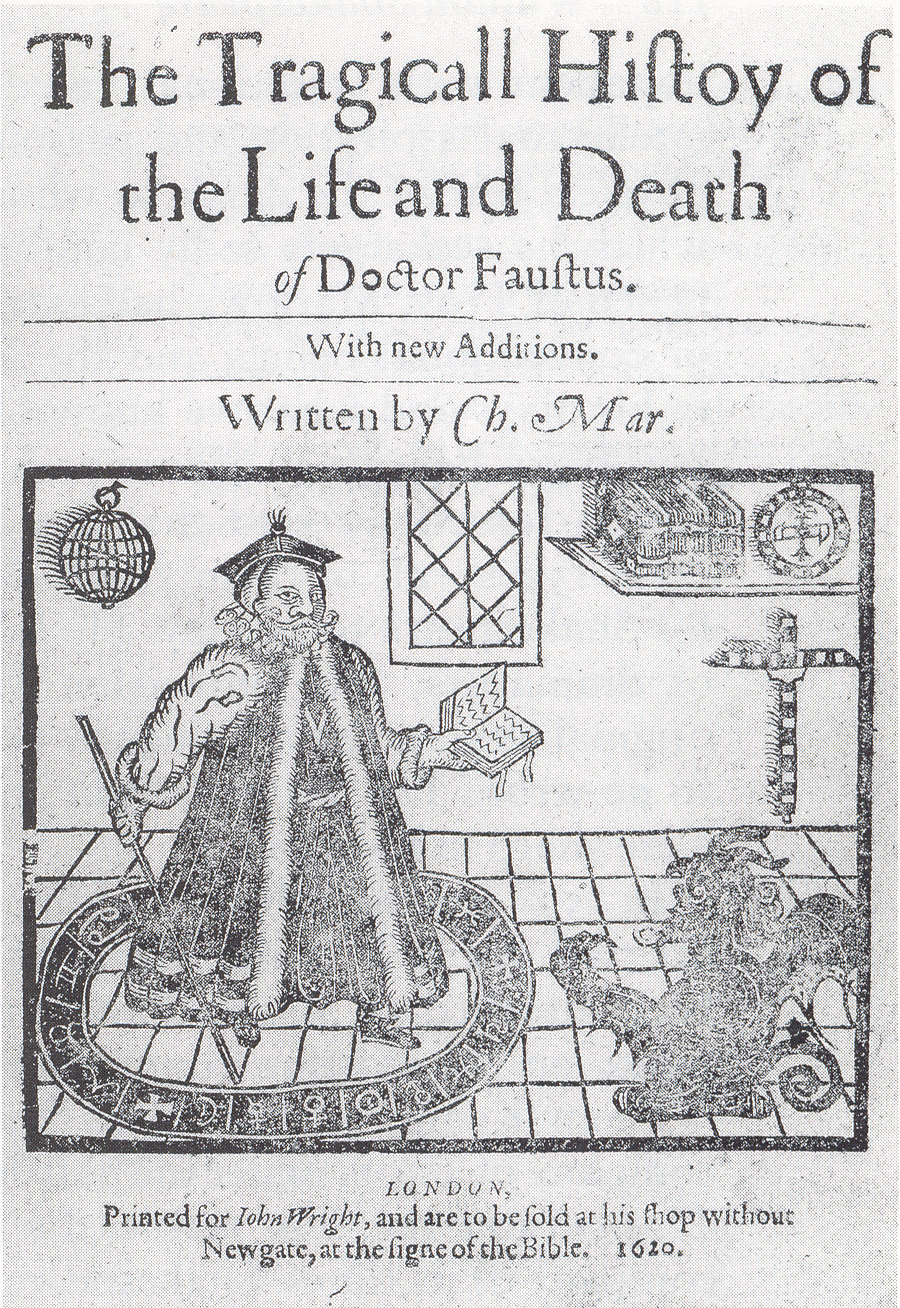
While the cross in the background, the books on the shelf, and the astrological symbols traced on the floor record the indebtedness of magical practice to religious and intellectual notions, their presence also suggests Faustus’s repeated appropriation and inversion of symbols, vocabulary, and logics from non-magical epistemic domains.
Alleyn’s performance invites further reflection on how seriously such symbolic inversions were taken within a culture that imagined conjuration as potentially efficacious. A Christian cross is mentioned as part of the costume in Samuel Rowlands’s satirical poem The Knave of Clubbes from 1609. Both Rowlands’s contemporaries as well as modern scholars sometimes interpret this cross as a safety measure on part of the actor – a detail which illustrates the anxiety surrounding magical enactment and its potential effects. Rumours suggest inadverted consequences of the conjuration scene (Act 1, Scene 3), including the appearance of “one devell too many” or the “apparition of the Devil”.4 One account in particular states that Alleyn was so afraid of the unexpected effects of his acting that he swore to make up for it by founding the charity College of God’s Gift, now Dulwich College.5 The reason for the popularity of these anecdotes lies in a specific quality of conjuration spells that allows them to undermine the safely fictional layer theatrical performance normally has: they are speech acts.
Speech Acts on Stage
Sentences like “I am King Henry”, spoken by an actor who clearly is not a king, and perhaps not even a Henry, hold no power to affect the reality of the audience. An expression like “I conjure thee”, however, causes speech and effect to collapse into each other. In saying the words, the action is being done. Similar, less grave cases include everyday utterances like “I wish you well” and “I beg your pardon” as well as more ceremonial sentences like “I hereby pronounce you husband and wife”. However, these latter examples contain additional, implicit safeguards when spoken on an early modern stage. For a marriage ceremony to be successful, the presence of an actual churchman was required, and concerning the more casual idioms, there was an implicit understanding that one character was speaking to another instead of the actor addressing his colleague. As J. L. Austin, whose How to Do Things with Words is often considered to be the foundational text of speech act theory, points out: “Language in such circumstances is in special ways – intelligibly – used not seriously”.6 While one might debate the use of the word ‘seriously’, the main observation is fitting: Theatre makes its fictionality known in ways that are intelligible to the audience members and keeps them from assuming that actors must now be married because they said so on stage.
In magical thought, however, it is the very word itself that holds power, and thus, certain expressions can be dangerous, even in the usually fictional context of stage performance. As Mary Thomas Crane points out in her essay What Was Performance?, the word perform could mean more than one thing in early modern use: “The relationship between the performed and the real was much more complex and uncertain, with at least a possibility that the act of performing itself constituted an ‘exercise’ that effected material change in the world.”7 In this way, magic is performed in a double sense on stage: it is represented, but it is also executed. In magical utterances, proclaiming and effecting are inseparably entangled. When specific words are spoken, an effect takes place in the world, something becomes something else, and someone becomes a magic practitioner.
“The utterance constructs the speaking subject as a conjuror; the spell makes the magus, rather than vice versa”8, writes Andrew Sofer in How to Do Things with Demons. Following this logic, Alleyn becomes, in the moment and by virtue of speaking the conjuration, just as much of a magus as Faustus is – or is not. Actor and acted figure become one in a way they normally would not: they are both dependent on the outcome of the conjuration ritual, and they are both balancing precariously on the fine line between fiction and reality. While there is no guarantee that a demon will appear, there can also be no absolute certainty that it will not.
The reason for this specific quality of occult speech acts as opposed to others can be found in an almost throwaway comment that Austin makes while describing the functionality of speech acts: “to utter the sentence (in, of course, the appropriate circumstances) is not to describe my doing […] or to state that I am doing it: it is to do it.”9 However, these ‘appropriate circumstances’ are not as unambiguous and intuitive as Austin makes them sound when it comes to magic. While it is clear to audience members that a marriage cannot be sealed by an actor who is not a learned churchman, their knowledge about the occult will be less secure.
The exclusivity of occult knowledge and magical thought is in part due to the academically elitist dimension of conjuring and demonic magic, but it is also very much a defining feature of the occult per definition. The word ‘occult’ derives from the Latin term occultus10, which means ‘hidden’. This implies a fundamental inaccessibility of certain types of knowledge and information to certain social groups. Practices, services, and knowledge that are obvious, readily available, or accessible to everybody can by definition not be occult.
An audience member of any class and standing would have been able to tell that one did not become king by simply announcing it, or that an on-stage marriage must be pretence – if not because of the missing clergyman, then at least because the actors, under their costumes, were both men. At the same time, however, they might not have been equally able to discern whether a magic circle had been drawn correctly, whether the spell in Faustus’s book had any ‘real’ power, or whether the actor’s gestures were expressions of grandeur or ritual accuracy. Neither, for that matter, might the actor himself. Since no involved party can have certainty about the correct circumstances required to enable a spell to work, or the degree to which the stage setup corresponds with these rules, there can neither be any certainty that the stage arrangement is an incorrect frame for the conjuring. Through this introduction of genuine uncertainty into the effects of stage plays on the audience, occult practices become impactful tools for the satisfaction of sensationalist cravings and the creation of lasting suspense, both of which characterise theatre as an early modern institution. As perhaps the only group of practices capable of undermining the willing suspension of disbelief on a regular basis, occult practices enjoyed a lasting popularity on the Tudor and Stuart stage, as evidenced by the large corpus of works featuring prophecies, charms, conjurations, and potions as well as magicians, witches, fairies, ghosts, and other supernatural stage personnel.
Public Opinion, Truth, and Belief
On stage magic having unwanted consequences, David Bevington remarks that “the hope of such an event was possibly one fascination that drew audiences to the play”.11 This suggests that the anxiety around Faustus and his demons was in fact a productive one that did not keep audiences from hearing and watching plays but rather compelled them to return repeatedly. Doctor Faustus was a great success in the years after its premiere, indicating that its treatment of the prevalent topics of magic and demonology was compatible with contemporary interests and anxieties as well as intellectual and social discourse.
Naturally, there were other voices who condemned theatre for its allegedly demonic practices and sinful effects. Such statements, like that of William Prynne in 1633, were based on the implication that the effect in question here was very much unimpaired and operational. Prynne explicitly mentions “the visible apparition of the Devill on the stage at the Belsavage Play-house, in Queene Elizabeths dayes, (to the great amazement both of the Actors and Spectators) whiles they were prophanely playing the History of Faustus”.12 In criticising theatre for its profanity and dangerous potential, Prynne effectively serves as valuable evidence for the gravity of the conjuring scene’s impact on contemporary audiences. He involuntarily attests the power inherent in performed practices of the occult, especially those that are speech acts. Considering the usual tendency of early modern anti-theatricalists to discredit stage performances by pointing out that everything the audience sees is merely pretence, and therefore of no consequence morally or otherwise, it is noteworthy that in this case the underlying accusation is the opposite: that theatrical performance can have consequences that are too real, and as a result dangerous.
Ultimately, the most fruitful course of further inquiry lies not in determining whether Edward Alleyn actually wore a cross on stage for the purpose of protecting himself, or whether the accounts of real, additional devils appearing are in fact ‘true’ in the sense of corresponding to people’s experiences. Instead, it is crucial to examine the willingness of contemporary Elizabethan audience members and critics alike to entertain the possibility of accidentally summoning a demon through the inherent power of the words spoken on stage. These anecdotes were considered believable for an early modern audience to a degree which allowed for their development into sensational stories, anti-theatricalist arguments, or founding myths. This widespread circulation reveals the relevance of early modern witness accounts as analytical material: They are not unequivocal historical truths, but markers of virulent topics, prevalent mindsets, and social undercurrents.
Occult Practice as a Historical Lens
Literary criticism tends to domesticate magic on stage by reducing it to metaphor. The witches in Macbeth become a symbol of ambition and greed, Prospero’s magic in The Tempest serves as a poorly disguised stand-in for Shakespeare’s own writing, and Faustus is read as a reflection of religious tensions and Marlowe’s supposed atheism rather than a play about magic and demonology. But the early modern staging practices and aesthetics of effect much rather suggest that magic functioned as a dramaturgical tool rather than symbolic shorthand, creating experiential uncertainty and anxious tension in the audience.
Alleyn’s cross, whether historical fact or anecdote, is both a consequence and a representation of this specific anxiety. If we take magic seriously as a form of lived epistemological uncertainty on and off stage, it becomes a unique lens through which early modern society and its intellectual currents can be explored.
References
- Andrew Sofer, “How To Do Things With Demons: Conjuring Performatives in Doctor Faustus,” Theatre Journal 61.1 (2009), 1–22, here 1, https://doi.org/10.1353/tj.0.0154.
- Samuel Rowlands, The Complete Works of Samuel Rowlands, vol. 2 (Johnson Reprint Company, 1966), n.p.
- Jeff Barton, cataloguer at Princeton University’s Cotsen Library, expands on this in a post on the university’s blogpage: Jeff Barton, “Recycling Wizards, or, Timely Warnings to Rash and Disobedient Children and Adults,” Cotsen Children’s Library Blog, September 18, 2018, https://blogs.princeton.edu/cotsen/tag/timely-warning-to-rash-and-disobedient-children/.
- Both quoted by E. K. Chambers in The Elizabethan Stage, vol. 3 (Clarendon Press, 1923), 3:423–24, who collects several mentions of this anecdote, which he calls a ‘mythos’.
- Ibid.
- J. L. Austin, How to Do Things with Words (Harvard University Press, 1962), 22.
- Mary Thomas Crane, “What Was Performance?,” Criticism 43.2 (2001), 169–87, here 184, https://doi.org/10.1353/crt.2001.0013.
- Sofer, “How To Do Things With Demons,” 4.
- Austin, How to Do Things with Words, 6.
- Oxford English Dictionary, s.v. “occult (adj. & n.),” December 2025, https://doi.org/10.1093/OED/4802339947.
- David Bevington, “Introduction to Doctor Faustus,” in English Renaissance Drama: A Norton Anthology, ed. David Bevington et al. (W. W. Norton, 2002), 249.
- William Prynne, Histrio-Mastix (London, 1633), cited in Millar Maclure (ed.), Marlowe: The Critical Heritage, 1588–1896 (Routledge/Kegan Paul, 1979), 48.
SUGGESTED CITATION: Ziermann, Anthea: "But may I raise up spirits when I please?". The Precariousness of Performing Magic on the Early Modern English Stage, in: KWI-BLOG, [https://blog.kulturwissenschaften.de/but-may-i-raise-up-spiritis/], 12.05.2026