Rule by Algorithm
Horror stories about bureaucracy have long haunted literature, from Charles Dickens’s depiction of the Chancery Court in Bleak House (1853) and the infamous Circumlocution Office in Little Dorrit (1857) to Franz Kafka’s The Castle (1926), George Orwell’s 1984 (1949), and Joseph Heller’s Catch-22 (1961). Contemporary writers, such as Helen Phillips in The Beautiful Bureaucrat (2015) and Matías Celedón in Autor Material (2023), continue to mine the theme. What unites these works is a fascination with the dreadfulness of a “rule by Nobody,”1 as Hannah Arendt once put it or, in a different register, with what Michel Foucault termed the “administrative grotesque”.2 Literature, in other words, has long captured the anxiety that arises when power hides behind impersonal rules and roles.
This type of narrative is not confined to literary works; it is also prevalent in public conversations about bureaucracy. As the anthropologist Michael Herzfeld has noted, “everyone, it seems, has a bureaucratic horror story to tell”.3 Indeed, such stories often permeate the political discourse. Campaigns running on populist anti-bureaucratic sentiment have been prominent in UK politics (from Thatcher to Brexit to “the Blob”4), as in Javier Milei’s Argentina5 and in Europe more broadly.6 But the most prominent recent example is perhaps the PR surrounding the exploits of the US Department of Government Efficiency–or DOGE–initially directed by Elon Musk.
Anti-bureaucratic sentiment is not a new phenomenon in US politics. Ronald Reagan famously suggested in a presidential speech that “the nine most terrifying words in the English language are: I’m from the Government, and I’m here to help”.7 However, with its unofficial slogan of “uncovering waste, fraud, and abuse,”8 DOGE took governmental bureaucratic horror story-telling to a new level. Indeed, the Trump administration’s messaging about DOGE has consisted of salacious details concerning expenditure on purportedly illegitimate foreign aid projects, government departments writing out untraceable blank checks, and fraudulent welfare recipients who may be, as Trump gleefully (and falsely) claimed in one of his speeches to Congress, three-hundred years old.9 This uncanny image of the administrative undead is the epitome of bureaucratic horror story-telling.
The stated aim of DOGE is improved efficiency in the face of major government debt. Meanwhile, left-leaning critics call it out as technocratic austerity politics. And yet, the feverish pitch of the PR campaign surrounding DOGE is perhaps above all the result of the Trump administration’s ambition to expand the use of AI in public administration. The DOGE project, then, constitutes a decisive move towards a new form of e-governance that is being marketed as post-bureaucratic. Tellingly, Musk referred to himself as governmental “tech support.”10 In one of many widely disseminated interviews about DOGE and its findings, he proclaimed: “We found just with a basic search of the social security database that there were 20 million dead people marked as alive.”11 Here, the AI-component of DOGE is presented as an antidote to fraudulence and excessive bureaucracy.
In the latest variation of the bureaucratic horror story – the one that the architects of DOGE insist on telling – artificial intelligence emerges as the hero. Over the past decades, bureaucracy, which literally means “rule by desk,”12 has gradually evolved into rule by computer, and, as epitomised by the rise of DOGE, it now appears to be moving in the direction of rule by AI, or “algorithmic bureaucracy”.13 If the history of bureaucracy-related technological innovation tells us anything, it is that the incorporation of AI into bureaucratic statecraft is likely to bring about problems of its own.
Record-keeping and data-processing technologies have always been central to how states simplify, standardize, and ultimately control social complexity, which is why each new medium shapes how power is organized and exercised. Thinkers like James C. Scott, Jack Goody, Friedrich Kittler, and Cornelia Vismann remind us that such tools are never neutral: the material formats of administration actively structure authority. Seen in this light, algorithmic governance is not a radical break but the latest chapter in a long history of technologies that promise efficiency while embedding new forms of surveillance, coercion, and exclusion.
As Max Weber noticed over a century ago, bureaucracy’s foundation in formalised rules and hierarchical structures renders it peculiarly resilient to political upheavals and technological disruptions.14 It adapts, chameleon-like, to new regimes and innovations, while preserving its essential character. Each technological leap – from cuneiforms to databases – has extended the reach of administrative systems and simultaneously generated its own folklore of horror: the mere necessity of transposing data into new formats is prone to generate errors that result in Kafkaesque nightmares. Other recurrent tropes are the panoptical gaze of unforgiving surveillance mechanisms and the reduction of human complexity to optimized cogs in the proverbial machine.
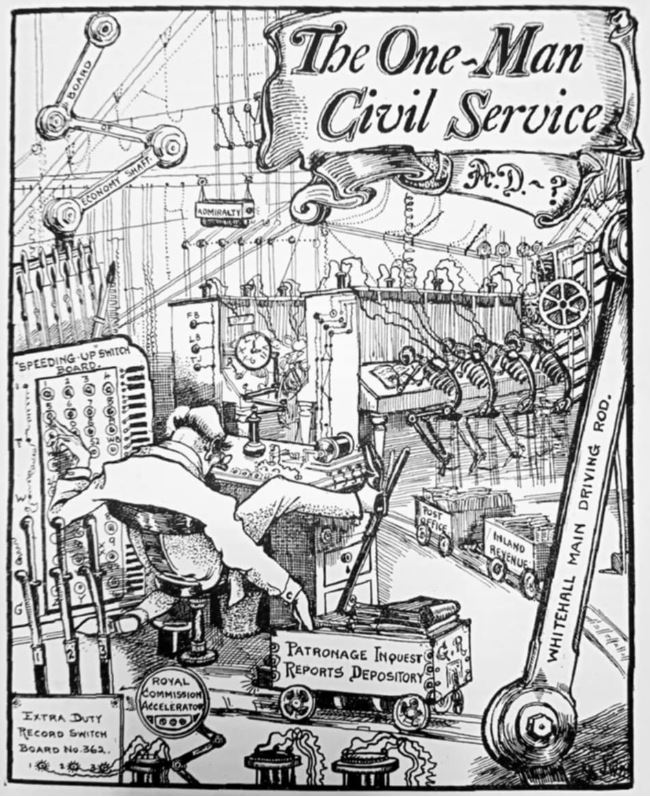
Writers and artists have generally treated the prospect of technological innovation within the sphere of administrative statecraft with suspicion and fear. Visions of administrative mechanisation and automation may be found already in Edwardian-era literary and pictorial representations of state bureaucracy. In A Modern Utopia (1905), H. G. Wells imagines a future administrative world state operating a pre-digital biometric database. Whilst Wells embraced such administrative technologies, many critics, including Aldous Huxley, who would go on to write Brave New World (1932), regarded Wells’s sci-fi vision of high-technological world governance not as utopian but rather as nightmarish.15 More in line with the popular bureaucratic imaginary, then, was the dystopian bureaucratic sci-fi of Vernon Hill and Juan W. P. Chamberlin’s “A Prophetic Nightmare” (Fig. 1), a cartoon published in Red Tape: A Civil Service Magazine in January 1912.16 In this comic, Whitehall has been reduced to a ghastly mechanical administrative system operated by a single civil servant, assisted by skeletal clerks connected by wires to his switchboard. Whilst the comic does not predict algorithmic bureaucracy per se, it certainly points in the direction of downscaling the public service workforce by technological means.
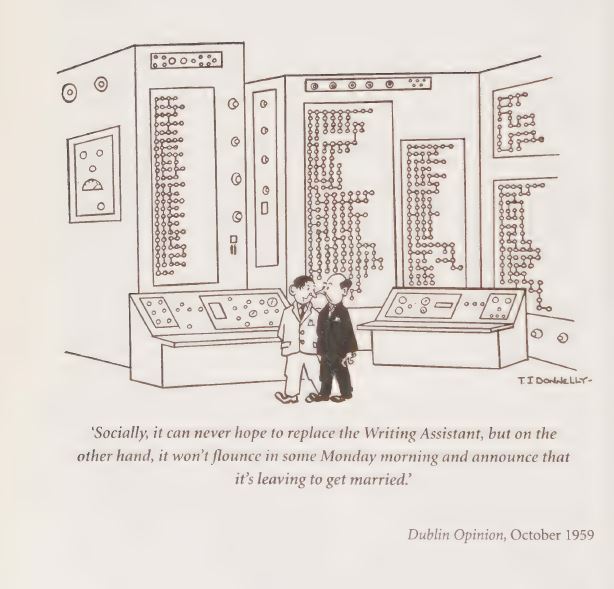
During the postwar era, the ethical and practical consequences of computerisation began to be scrutinised by writers and artists, not least by those who were also civil servants and thus experienced administrative mechanisation first hand. As Max Weber notes, depersonalisation is ingrained in the very logic of bureaucratic rationality. However, where discretion may be exerted by state functionaries there is also humanity in bureaucracies. The advantages and disadvantages of administrative digitalisation are weighed against each other in a cartoon by T. J. Donnelly (Fig. 2) published in the October 1959 issue of the Irish magazine Dublin Opinion, without settling the question of whether administrative computer systems are preferable to feminized “Writer Assistants”.
In a witty preface to his short 1961 novel Memoirs Found in a Bathtub, Polish sci-fi writer Stanisław Lem imagines archaeologists from the thirty-ninth century uncovering a peculiar document from our civilization. They report that a catastrophic event called the “Great Papyralysis” occurred around 2150 AD, when a bioengineered virus caused all paper-based records to rapidly decompose. This event effectively erased most historical information from our time. The discovered manuscript (the material support of the main narrative) survived only because it was produced under very specific protocols: written on synthetic paper and stored in a hermetically sealed military bunker deep underground. This sophisticated administrative setup enables a biting satire of the governance culture of pre-Papyralysis America, while simultaneously deriding a paperless bureaucracy akin to a digital dystopia. By the end of the novel, the goal of government efficiency breaks down into a paranoid, self-referential document circuitry that proves not only completely redundant, but also ultimately self-destructive.18
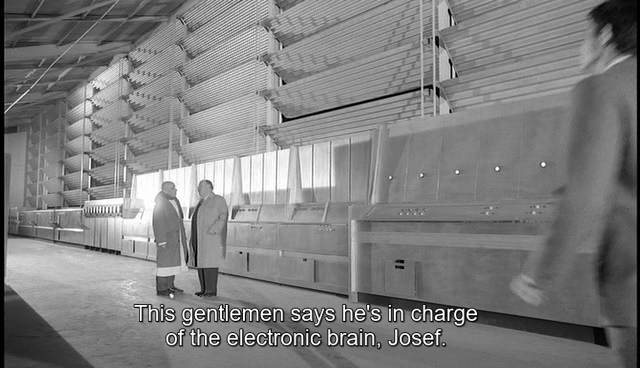
Likely under the spell of the cybernetics hype hovering over the 1950s, Orson Welles’s 1962 eponymous adaptation of The Trial adds to the original Kafkaesque plot a scene in which an administrative computer is tasked with solving the mystery of Joseph K.’s charges (Fig. 3).
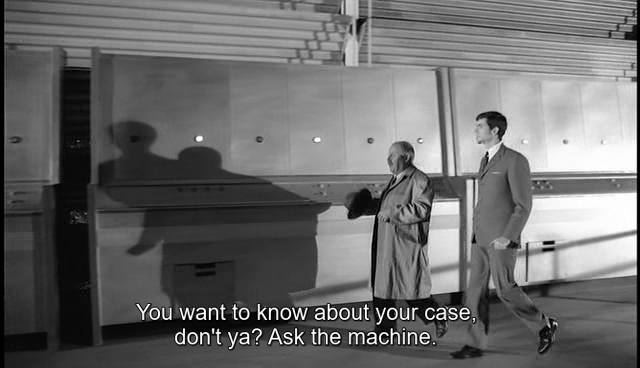
Although presented as a cutting-edge technology with uncanny talents in emulating human behaviour, even generating affective responses, this fictional AI – also referred to as an “electronic brain” – does nothing but fuel Joseph K.’s nightmare. Unsurprisingly, despite occupying an entire warehouse and being fed “an awful lot of material,” the computer proves unable to deliver any clear and conclusive results.19
At the turn of the twenty-first century, integrated supranational databases were paired with biometrics to create transnational systems of surveillance. The European Union’s efforts in this regard are satirised in Hari Kunzru’s Transmission (2004), which describes the operations of a fictional “Pan European Border Authority”.20 This authority sets out to “combine the database with biometrics” in order to “cut through everything,”21 much as DOGE goes about using AI to create an integrated master-database for surveillance and tracking purposes that are part of a strict anti-immigration agenda.22 In Transmission, the introduction of the biometric database does not prove a panacea for all identification-related problems. The aim is to expose the “lies” of asylum seekers, and yet, when a computer virus infects the new database, it starts to create its own “lies,” as ordinary citizens of EU countries are erroneously identified by the system as “known criminals, failed asylum seekers or persons being monitored by European intelligence services”.23 Ironically, when the new authority orchestrates its first big mass deportation, its leading PR agent is mistakenly identified as a “suspected pyramid fraudster and failed asylum seeker”24 and expelled from the EU. This bears an uncanny resemblance to recent news, with Donald Trump threatening in a post on Truth Social to use DOGE against its main PR figure, Elon Musk.25
As DOGE claims to write a new chapter in the history of state administration, from rule by desk to rule by AI, we find ourselves at a familiar crossroads. The techno-utopian promise of government efficiency, achieved with the help of machines and their intelligence, echoes previous technological revolutions that claimed to solve grotesque malfunctions of the administrative kind, only to end up reproducing them in more sophisticated forms. It appears with increasing clarity, one computational leap after another, that the bureaucratic horror story refuses to disappear. Instead, it mutates alongside its technical means: from Dickens’s labyrinthine Circumlocution Office to Lem’s paranoid document circuitry, from Welles’s warehouse-sized “electronic brain” to Kunzru’s virus-infected biometric database.
What this fictional tradition seems to suggest is that DOGE’s algorithm-powered crusade against “waste, fraud, and abuse” may well produce its own bureaucratic nightmares, as the fundamental tensions of administration (between efficiency and accountability, procedural rationality and social justice) cannot be resolved through technological means alone. If anything, the turn to AI intensifies the bureaucratic horror story: the fantasy of purging inefficiency is turned into a justification for automating decision-making, often without human recourse, at a scale and speed that oversimplifies complex cases and makes appeals more difficult. Historically, the introduction of new administrative technologies always comes with the promise of rational order and delivers, alongside an approximation of such order, new forms of confusion, exclusion, and harm. It might be that the true horror of bureaucracy lies not in its errors and inefficiencies, but in the fantasy of total efficiency itself. And, of course, in its constant ideological hijacking under the guise of a rule by Nobody.
References
- Arendt, Hannah (1970): On Violence, New York: Harcourt, Brace & World, p. 38: “bureaucracy or the rule of an intricate system of bureaus in which no men, neither one nor the best, neither the few nor the many, can be held responsible, and which could be properly called rule by Nobody”.
- Foucault, Michel (2003): Abnormal: Lectures at the College de France, 1974-1975, New York: Picador, p. 13.
- Herzfeld, Michael (1992): The Social Production of Indifference: Exploring the Symbolic Roots of Western Bureaucracy, Chicago/London: University of Chicago Press, p. 4.
- Seddon, Paul (2023): Calling us the Blob is insulting, says top civil servant, on: BBC, 12/07/2023 (Last Access: 23.08.2025).
- Witthaus, Jan-Henrik (2025): Weniger Milei wagen. Ein Gastkommentar, on: Das Lateinamerika Magazin, 21/02/2025 (Last Access: 23.08.2025).
- For an article on the Romanian context, see Irimia, Alexandra (2025): Retorica anti-birocratică a populismului, on: Scena 9, 15/05/2025 (Last Access: 23.08.2025).
- Reagan, Ronald (1986): President’s News Conference of August 12, 1986, on: Reagan Library (Last Access: 23.08.2025).
- House Committee on Oversight and Government Reform (2025): Locking in the DOGE Cuts: Ending Waste, Fraud, and Abuse for Good (Hearing, Subcommittee on Delivering on Government Efficiency), on: U.S. House of Representatives, 24/06/2025 (Last Access: 23.08.2025).
- NPR’s annotated fact check of President Trump’s address to Congress, on: NPR, 04/03/2025 (Last Access: 23.08.2025).
- Knickmeyer, Ellen (2025): Musk and His ‘Humble Tech Support’ Effort Get Star Turn at Trump’s Cabinet Meeting, on: AP News, 26/02/2025 (Last Access: 23.08.2025).
- Horvath, Bruna (2025): Elon Musk takes familiar fraud, waste claims to Joe Rogan with DOGE discussion, on: NBC News, 01/03/2025 (Last Access: 23.08.2025).
- Kafka, Ben (2012): The Demon of Writing: Powers and Failures of Paperwork, New York: Zone Books, p. 77, https://doi.org/10.2307/j.ctv14gpj6p.
- Vogl, Thomas et al. (2019): Algorithmic Bureaucracy. Proceedings of the 20th Annual International Conference on Digital Government Research, New York: ACM Press, pp. 148–153, https://doi.org/10.1145/3325112.3325240.
- Weber, Max (1978): Bureaucracy, in: Günther Roth and Claus Wittich (eds.): Economy and Society. An Outline of Interpretive Sociology, Berkeley/Los Angeles, London: University of California Press, pp. 956–1005.
- For an extended discussion of bureaucratic horror stories in Victorian and modernist British literature, see Foster, Jonathan (2025): Writing the State: Administrative Fiction in Long-Nineteenth-Century Britain. PhD Thesis, Stockholm: Stockholm University.
- Hill, Vernon and Juan W. P. Chamberlin (1912): A Prophetic Nightmare, in: Red Tape: A Civil Service Magazine 1.4, p. 7.
- Image sourced from: Mulreany, Michael and Denis O’Brien (eds.) (2011): Lord of the Files: Working for Government – An Anthology, Dublin: Institute of Public Administration, p. 402.
- Lem, Stanislaw (1986): Memoirs Found in a Bathtub. Translated by Rose Adele Kandel, New York: Avon Books.
- Welles, Orson (1962): The Trial.
- Kunzru, Hari (2005): Transmission, London: Penguin, p. 123.
- Ibid., p. 238.
- Kelly, Makana and Vittoria Elliott (2025): DOGE Is Building a Master Database to Surveil and Track Immigrants, on: Wired, 18/04/2025 (Last Access: 23.08.2025).
- Kunzru 2005, p. 268.
- Ibid., p. 268.
- Phillips, Aleks (2025): Trump threatens to set Doge on Musk as pair feud again over budget plan, on: BBC [https://www.bbc.com/news/articles/czdvv2qqlrqo], 01/07/2025 (Last Access: 23.08.2025).
SUGGESTED CITATION: Foster, Jonathan; Irimia, Alexandra: Rule by Algorithm. A Bureaucratic Horror Story, in: KWI-BLOG, [https://blog.kulturwissenschaften.de/rule-by-algorithm/], 06.10.2025