Life Finds a Way
One of the most otherworldly images to emerge from the battlefields of Ukraine are photographs of landscapes covered in fiber optic cables left behind by drones. Glistening like a spiderweb in sunlight, these tangled wires pose an ongoing threat to humans, vehicles, and wildlife. Yet amid the debris of modern warfare, a few members of the Ukrainian armed forces have found something truly remarkable: birds’ nests woven from fiber optic cables. These intriguing specimens have attracted media interest, and the ability of birds to build nests from the most unlikely material – while in the middle of an active warzone – has been portrayed as a symbol of the resilience of Ukraine and its wildlife.1
Nests made from fiber optic cables are an extreme example of how some birds use what scientists call anthropogenic nest material, or ANM. As the name suggests, these are human-made objects or substances that end up incorporated into the structure of birds’ nests. Biologists have uncovered many examples of how nesting birds have apparently adapted to modern environments by using anthropogenic material. Japanese crows (Corvus corone and Corvus macrorhynchos) build nests from colorful coat hangers, Mexican house sparrows (Passer domesticus) and house finches (Carpodacus mexicanus) harness the insecticidal properties of cigarette butts, and Spanish black kites (Milvus migrans) decorate their nests with white plastic from shopping bags. In the Netherlands, scientists have excavated decades of human litter that forms the nests of Eurasian coots (Fulica atra) in Amsterdam, and they were even alerted to the presence of a magpie (Pica pica) nest in Antwerp made from anti-bird spikes.2
Photographed in high definition from every possible angle and circulated over social media, these unusual nests give off distinctly modern vibes that combine internet celebrity with a sense of environmental crisis. Yet, as the famous biologist J. B. S. Haldane remarked, “everything has a history”.3 These artificial nests are no exception. In a recent article for the history of science journal Endeavour, I explored how nests made from metal, string, horsehair, plastic, and other materials fascinated scientists and spurred debate on the environmental impact of humans and the intelligence of birds across the nineteenth and twentieth centuries.4 It turns out that birds have been using anthropogenic nest material for a long time. Some of these nests are held in museums, while others only exist as grainy photographs or illustrations in natural history books. They show how birds have been collecting bits and pieces of our homes, industries, and infrastructure for centuries, giving a rare non-human insight into the history of our species.
While fiber optic cables and plastic bags are reflective of the twenty-first century, life in the nineteenth century would have been unthinkable without a myriad of textiles and fibers for clothing, rope, string, sails, carpet, and more. Sewing was an indispensable skill during this time but was not without its dangers. In 1877 Henry Davis Minot, an amateur ornithologist and Harvard classmate of future President Theodore Roosevelt, warned readers of Scientific American about thieving birds. “Leave your knitting under a tree for five minutes”, he cautioned, “and it is gone; you will find it a week later, a part irrevocably woven into the hanging nest, and a part dangling with the needle in it”.5 Minot was intrigued by the willingness of wild birds to use human-made materials to build their nests, especially when natural alternatives were readily available. He began to experiment by leaving cotton wool, horsehairs, string, straw, and cloth outside. Birds, it turned out, were more than happy to make use of these fabrics in their nests. Orioles (members of the Icterus genus), which usually wove nests from grass and plant fibers, were particularly fascinated by these textiles. Minot was even able to get the birds to build a colorful nest by giving them bright silk and yarn.
These experiments were not just for fun. The mental abilities of non-human animals were a matter of serious scientific debate in the nineteenth century. Naturalists repeatedly clashed over whether animal structures, including birds’ nests and beavers’ dams, were proof of intelligence.6 Different species of bird built different kinds of nests. Some simply scratched a hollow into the ground or laid down a twig or two (think of the infamously minimalist nests of urban pigeons). Other birds wove elaborate nests, built pipe-shaped homes out of clay from riverbanks, or even decorated their dwellings. These differences between species, argued some nineteenth-century ornithologists who embraced contemporary colonialist and race ideology, were akin to the differences between so-called “primitive” and “civilized” peoples.7 Birds within the same species could also differ in how they built their nests. Thomas George Gentry, a Philadelphia teacher and nature writer, described how birds that built close to human homes would use string, silk, bunches of wool and cotton, or even bits of carpet in their nests. For Gentry, this versatility demonstrated the ability of birds to reason, a thought process then regarded as the highest form of intelligence.8
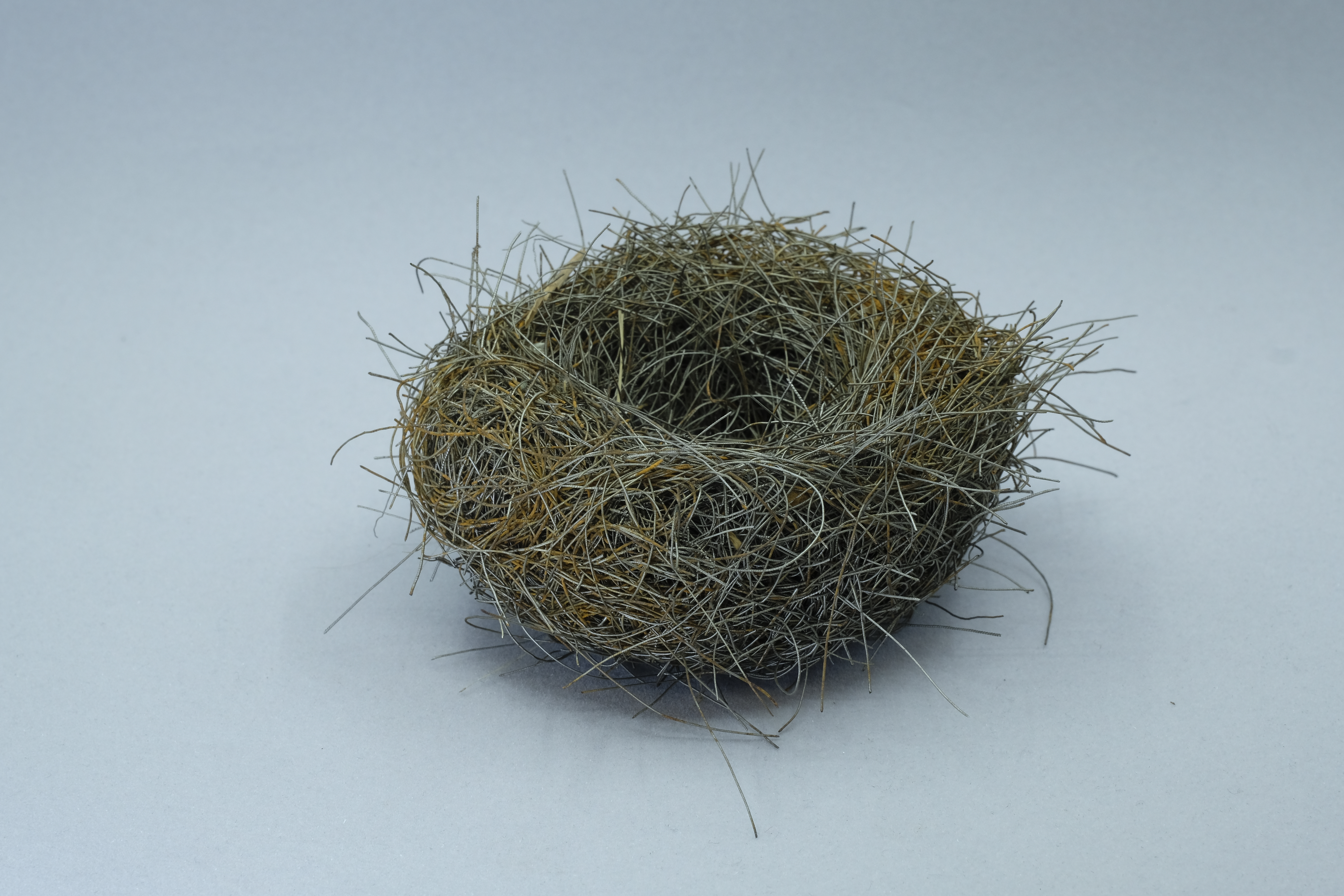
Even more striking than nests of cloth and string were those made from metal. In 1885 the nest of a white wagtail (Motacilla alba) was found near the factory of the Langendorf Watch Company in Solothurn, Switzerland (Fig. 1). Reflecting one of the famous products of the region, this nest was made almost entirely of metal watch springs. The Solothurn nest was an industrial nest worthy of an industrial age. Its avian builders were described as “architects” who were “enterprising” and “intelligent”.9 This nest can still be seen at the Naturmuseum Solothurn today. Other examples of metal nests would soon follow. In 1898 several nests belonging to urban pigeons (a domesticated form of the rock dove, Columba livia) were found on the roof and grounds of London’s Crystal Palace, a great iron-and-glass structure built to host the Great Exhibition of 1851. One of these nests was made from hair pins, presumably dropped by visitors to the Crystal Palace and subsequently collected by pigeons.10 These visually striking (but quite uncomfortable-looking) nests fascinated people in the nineteenth century as much as their modern counterparts do today.
Yet the nineteenth-century conviction that birds’ nests were evidence of intelligence did not last. Animal psychologists began to criticize the old tendency to anthropomorphize animals and claimed that behavior like nest building was the result of instinct. French biologist Achille Urbain, the first holder of the chair of ethology (the study of animal behavior) at the Muséum national d’Histoire naturelle in Paris, argued that the Solothurn nest was one such case. Wagtails typically build their nests with sticks, which are a similar size and diameter to the watch springs. Urbain believed that the birds, driven by instinct, had been unable to distinguish between natural and artificial materials. By the twentieth century, the discovery of an artificial nest was not always a cause for celebration. In the 1930s the Great Plains of the United States were struck by a series of devastating dust storms. Settlement and agriculture had loosened the topsoil of the region, with a subsequent drought leading to wind erosion. Termed the “Dust Bowl,” this event quickly became synonymous with economic decline and ecological devastation. Photographers from the American newsreel series the March of Time joined other reporters in a rush to Texas to photograph nests of American crows (Corvus brachyrhynchos) made from barbed wire.11 Two members of the Great Plains Drought Area Committee, a group set up by President Franklin Delano Roosevelt in 1936 to investigate the factors behind the Dust Bowl, were photographed peering up at a barbed wire nest in a dead tree. Barbed wire nests had become symbols of desolation.
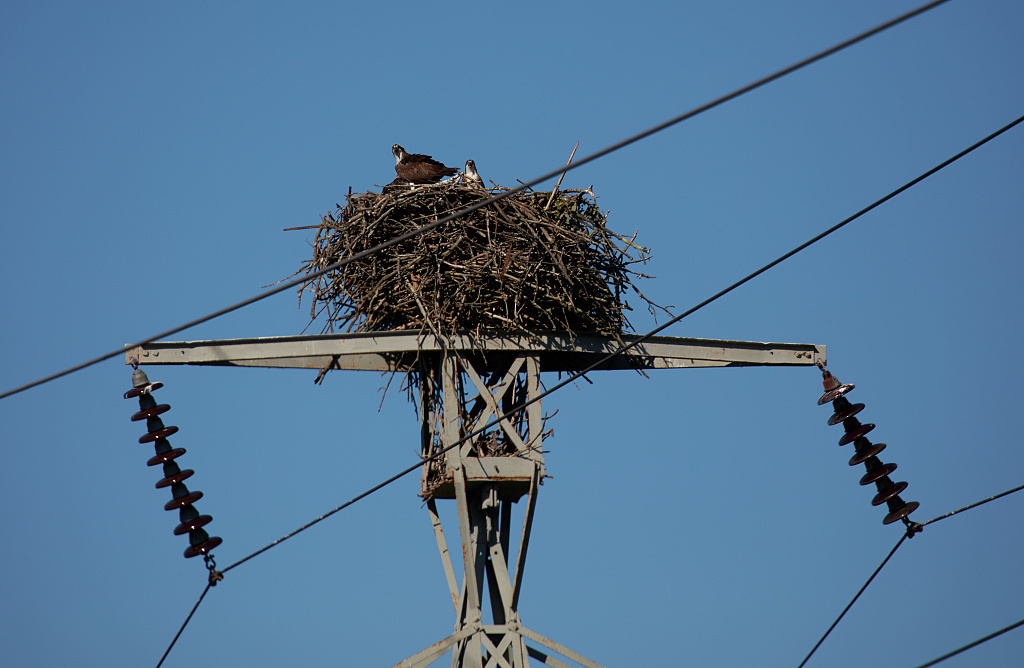
Today, corvids are recognized as some of the most intelligent bird species. However, their ability to harness metal and other materials for their nests has not always been welcomed. During the 1970s, house crows (Corvus splendens) in Indian cities began to build nests on top of electrical towers and pylons (Fig. 2). This was a problem because the crows seemed to favor metal objects as the basis of their nests, displaying a particularly strong interest in metal coat hangers. When it rained, the metal nests caused short circuits and power outages. House crows repeated the same behavior elsewhere. In Mombasa, Kenya, house crows introduced from India roam through parks, gardens, and refuse centers for nesting material, which frequently included steel wire.12 Metal nests have some advantages over their natural counterparts. They can retain heat for longer and are less susceptible to infestations of insects and parasites. However, the attraction of crows to specific objects like coat hangers is harder to explain in purely utilitarian terms.
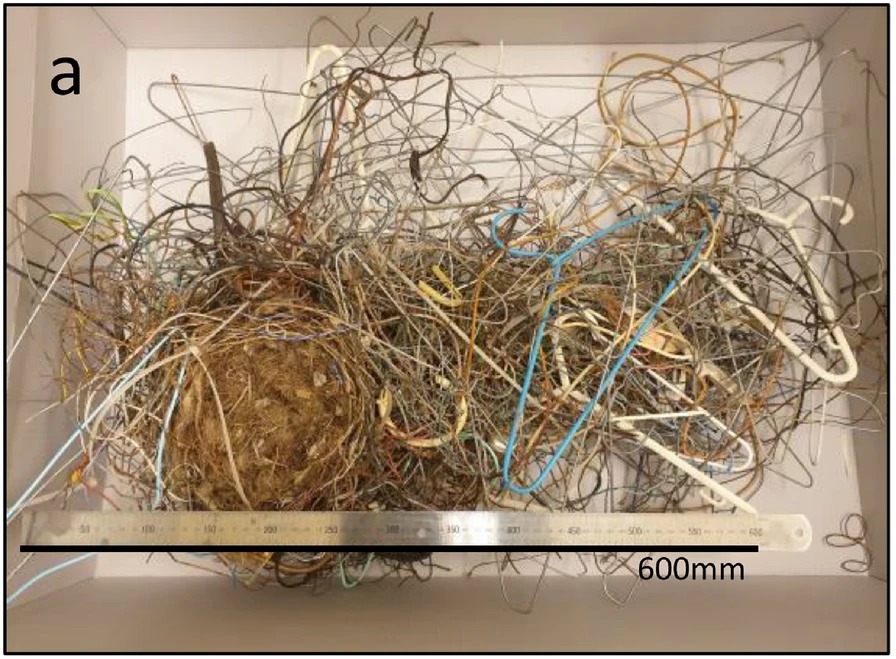
Over the course of the twentieth century, the nature of anthropogenic nest material has undergone a transformation. Synthetic plastics have become increasingly common in birds’ nests (Fig. 3). Biologists are naturally concerned by this trend. Even without considering the wider problems of global plastic pollution, building with plastic is dangerous for birds who might ingest it or become entangled.13 Attitudes towards anthropogenic nest material are now decidedly mixed. On the one hand, the ability of birds to harness unfamiliar substances is admired as a sign of avian resilience and cleverness in the face of environmental change. On the other, the growing prevalence of anthropogenic nest material, particularly plastic, is viewed with trepidation as indicative of a wider environmental crisis that has seen global bird populations decline. Just as in previous centuries, anthropogenic nest material elicits both admiration for the inventiveness of animals and fear for the state of the natural world.
References
- David Hambling, “Fiber Optic Bird’s Nest Heralds a Fiber Drone Summer in Ukraine,” Forbes (2025), https://www.forbes.com/sites/davidhambling/2025/06/06/fiber-optic-birds-nest-heralds-a-fiber-drone-summer-in-ukraine/.
- See Menno Schilthuizen and Jono Nussbaum, The Urban Naturalist: How to Make the City Your Scientific Playground (The MIT Press, 2025), Chapter 13, https://doi.org/10.7551/mitpress/14943.001.0001.
- J. B. S. Haldane, Everything Has a History (Allen and Unwin, 1951).
- Matthew Holmes, “Feathered Architects: Collecting Histories of Anthropogenic Material in Birds‘ Nests,” Endeavour 50.1–2 (2026). Article no. 101049. This piece is drawn from a wider book project at the KWI on how technology has shaped perceptions of avian minds. The article has been made open access and is available at: https://doi.org/10.1016/j.endeavour.2026.101049.
- Henry Davis Minot, “Birds’ Nests,” Scientific American 35.6 (1877), 389.
- See Miles A. Powell, Vanishing America: Species Extinction, Racial Peril, and the Origins of Conservation (Harvard University Press, 2016), especially 17f., https://doi.org/10.4159/9780674972957.
- British naturalists drew upon these colonial analogies as a means of denigrating peoples who opposed imperial expansion. See Holmes, “Feathered Architects,” 3.
- Thomas George Gentry, Nests and Eggs of Birds of the United States (J. A. Wagenseller, 1882).
- Holmes, “Feathered Architects,” 1.
- Ibid., 4.
- Donald Worster, Dust Bowl: The Southern Plains in the 1930s (Oxford University Press, 2004).
- Holmes, “Feathered Architects,” 6.
- Andrea K. Townsend and Christopher M. Barker, “Plastic and the Nest Entanglement of Urban and Agricultural Crows,” PLOS ONE 9.1 (2014). Article no. e88006, https://doi.org/10.1371/journal.pone.0088006.
SUGGESTED CITATION: Holmes, Matthew: Life Finds a Way. The Unnatural History of String, Metal, and Plastic in Bird's Nests, in: KWI-BLOG, [https://blog.kulturwissenschaften.de/life-finds-a-way/], 20.07.2026